

-
GET 10% OFF
- Publisher's listprice GBP 47.99
-
21 667 Ft (20 635 Ft + 5% VAT)
The price is estimated because at the time of ordering we do not know what conversion rates will apply to HUF / product currency when the book arrives. In case HUF is weaker, the price increases slightly, in case HUF is stronger, the price goes lower slightly.
- Discount 10% (cc. 2 167 Ft off)
- Discounted price 19 500 Ft (18 572 Ft + 5% VAT)
19 500 Ft

Availability
printed on demand
Why don't you give exact delivery time?
Delivery time is estimated on our previous experiences. We give estimations only, because we order from outside Hungary, and the delivery time mainly depends on how quickly the publisher supplies the book. Faster or slower deliveries both happen, but we do our best to supply as quickly as possible.
Product details:
- Edition number 1
- Publisher Taylor & Francis
- Date of Publication 26 December 2025
- ISBN 9781032705828
- Binding Paperback
- No. of pages240 pages
- Size 246x174 mm
- Weight 470 g
- Language English 759
Categories
Short description:
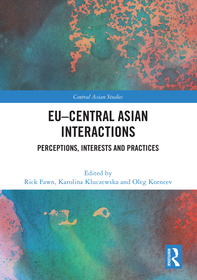
From limited interactions in the early 1990s, the EU and Central Asia now consider each other to be increasingly important. This book analyses multiple levels of mutual interactions, understandings and misunderstandings across a range of policy areas. The chapters were published over three issues of Central Asian Survey.
MoreLong description:
From limited interactions in the early 1990s, the EU and Central Asia now consider each other to be increasingly important. This book includes 12 chapters written by seasoned and policy-engaged researchers from across Eurasia and the wider world that analyse multiple levels of mutual interactions, understandings and misunderstandings across a range of policy areas. It shows why and in what ways exactly the EU and Central Asia matter to each other and why policymakers and researchers should pay more attention to their interactions.
Central Asia falls under the broader external relations and security agenda of the EU, and over years it provided a testing ground for many EU policies, including the priority ones of region-building and resilience promotion. Looking at the EU, in turn, informs as to how Central Asian actors interact with external partners of the region, and how that can influence national policy agendas and consequently everyday life – bringing new approaches, insights and evidence also to the wide field of EU studies.
This book is of key interest to scholars, practitioners and students of Central Asian history and politics, EU foreign policy, EU-Central Asia relations, and more broadly of EU studies, International Relations, regionalism and interregionalism as well as security studies. The chapters in this book were published over three issues of Central Asian Survey.
MoreTable of Contents:
Preface 1. EU–Central Asian interactions: perceptions, interests and practices 2. The EU’s Central Asia policy: no chance for change? 3. Learning in, about and from the field? Symbolic functions of EU knowledge production on Central Asia 4. ‘Not here for geopolitical interests or games’: the EU’s 2019 strategy and the regional and inter-regional competition for Central Asia 5. The interplay of narratives on regionness, regionhood and regionality: European Union and Central Asia 6. The EU and China: how do they fit in Central Asia? 7. Bridge or base? Chinese perceptions of Central Asia under Europeanisation 8. Opportunity and threat perceptions of the EU in Kazakhstan and Kyrgyzstan 9. Overlap with contestation? Comparing norms and policies of regional organizations in the post-Soviet space 10. European Union, civil society and local ownership in Kyrgyzstan: analysing patterns of adaptation, reinterpretation and contestation in the prevention of violent extremism (PVE) 11. The EU and European transnational companies in Central Asia: relocating agency in the energy sector 12. Communal self-governance as an alternative to neoliberal governance: proposing a post-development approach to EU resilience-building in Central Asia
More
