

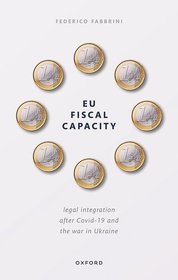
EU Fiscal Capacity
Legal Integration After Covid-19 and the War in Ukraine
- Publisher's listprice GBP 110.00
-
49 665 Ft (47 300 Ft + 5% VAT)
The price is estimated because at the time of ordering we do not know what conversion rates will apply to HUF / product currency when the book arrives. In case HUF is weaker, the price increases slightly, in case HUF is stronger, the price goes lower slightly.
- Discount 10% (cc. 4 967 Ft off)
- Discounted price 44 699 Ft (42 570 Ft + 5% VAT)
Subcribe now and take benefit of a favourable price.
Subscribe
49 665 Ft

Availability
printed on demand
Why don't you give exact delivery time?
Delivery time is estimated on our previous experiences. We give estimations only, because we order from outside Hungary, and the delivery time mainly depends on how quickly the publisher supplies the book. Faster or slower deliveries both happen, but we do our best to supply as quickly as possible.
Product details:
- Publisher OUP Oxford
- Date of Publication 8 December 2022
- ISBN 9780198874225
- Binding Hardback
- No. of pages192 pages
- Size 223x144x16 mm
- Weight 368 g
- Language English 244
Categories
Short description:
EU Fiscal Capacity: Legal Integration After Covid-19 and the War in Ukraine argues that the NGEU constiutes a profound overhaul in the EU architecture of economic governance. Moving away from the fiscal surveillance shown in response to the euro-crisis, the EU has adopted a strategy of fiscal federalism more akin to the United States.
MoreLong description:
The explosion of the Covid-19 pandemic in February 2020 led to a paradigm change in the European Union architecture of economic governance. To mitigate the pandemic's damage, the EU established a Recovery Fund called 'Next Generation EU' (NGEU). Funded though resources raised on the financial markets, this special budget is worth 750bn€ at 2018 prices, which corresponds to 806,9bn€ at current prices. Disbursed to member states in the form of both loans and grants and to be repaid on a long-term basis through the introduction of new EU taxes, the NGEU has endowed the EU with borrowing, spending, and taxing powers.
EU Fiscal Capacity: Legal Integration After Covid-19 and the War in Ukraine argues that the NGEU constiutes a profound overhaul in the EU architecture of economic governance. Moving away from the fiscal surveillance shown in response to the euro-crisis, the EU has adopted a strategy of fiscal federalism more akin to the United States.
The return of war in Europe following 75 years of peace has caused yet more socio-economic damage for the EU. Occuring as Europe was slowly re-emerging from the pandemic, the war in Ukraine has disrupted supply chains, increased humanitarian assistance costs, and generated an energy crisis. Within the context of war, the limitations of the current EU constitutional arrangements have yet again been exposed. EU Fiscal Capacity argues that the EU needs to retain the NGEU as a permanent feature of EMU.
The first book to analyse how the Covid-19 pandemic and the war in Ukraine have affected Europe's Economic & Monetary Union from an EU law and policy perspective, this book is a must read for policy makers and students of European law and politics alike.
In the highly polarized debate about fiscal federalism in Europe, Fabbrini has chosen his side and offers a vibrant and well-argued plea in favour of true federal budget and a more integrated and democratic Europe.
Table of Contents:
Introduction
EMU before Covid-19
EMU during Covid-19
EMU because of Covid-19
EMU beyond Covid-19
The EU beyond the war in Ukraine
Conclusion

