

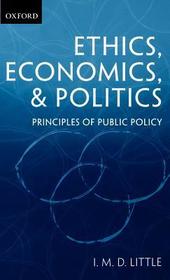
Ethics, Economics, and Politics
Principles of Public Policy
- Publisher's listprice GBP 105.00
-
47 407 Ft (45 150 Ft + 5% VAT)
The price is estimated because at the time of ordering we do not know what conversion rates will apply to HUF / product currency when the book arrives. In case HUF is weaker, the price increases slightly, in case HUF is stronger, the price goes lower slightly.
- Discount 10% (cc. 4 741 Ft off)
- Discounted price 42 667 Ft (40 635 Ft + 5% VAT)
Subcribe now and take benefit of a favourable price.
Subscribe
47 407 Ft

Availability
printed on demand
Why don't you give exact delivery time?
Delivery time is estimated on our previous experiences. We give estimations only, because we order from outside Hungary, and the delivery time mainly depends on how quickly the publisher supplies the book. Faster or slower deliveries both happen, but we do our best to supply as quickly as possible.
Product details:
- Publisher OUP Oxford
- Date of Publication 3 October 2002
- ISBN 9780199257041
- Binding Hardback
- No. of pages178 pages
- Size 224x144x14 mm
- Weight 321 g
- Language English 0
Categories
Short description:
Ian Little offers a new defence of utilitarianism as a basis for assessing the role of the State. Lucidly and elegantly he explains how the three disciplines of philosphy, economics, and politics can be integrated to provide guidance on issues of public policy. Anyone interested in public affairs will be enlightened by Little's crisp analysis and any student taking an interdisciplinary course in social science will find a clear framework for thinking about the subject.
MoreLong description:
This book studies the interfaces of ethics, economics, and politics. Public policy issues involve all three of these subjects. Although it may be seen as suggesting the nucleus of a joint university course, the book is accessible to and should interest all those concerned with political decisions. Any such decision needs a criterion for judging whether one action or outcome is better than another. Even a dictator must to some extent be concerned about the economic elfare of the citizens; and a democratic government more so. But how is a person's economic welfare to be judged? Furthermore, any political decision affects the economic welfare of different people differently. How then is the welfare of a community to be judged? This is an ethical question. Underlying any coherent public policy there must be a relevant moral code.
The reader is introduced to the classics of the PPE literature of the past fifty years ... Little comes across as an eminently sensible economist, a person of experience and sound judgement.
Table of Contents:
Introduction
Part I: Economics and Philosophy
Personal Utility and Welfare
Collective Utility and Welfare
Welfare Economics
Part II: Politics and Philosophy
The Role of the State
Utilitarianism: Theory and Application
Utilitarianism: Justice and Equality
Contractarianism
Communitarianism
Part III: Economics and Politics
Games, Conventions, and Public Goods
Positive Political Economy
Normative Political Economy
Part IV: The Principles of Public Policy
The Principles of Public Policy

