

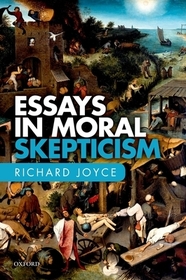
Essays in Moral Skepticism
- Publisher's listprice GBP 88.00
-
39 732 Ft (37 840 Ft + 5% VAT)
The price is estimated because at the time of ordering we do not know what conversion rates will apply to HUF / product currency when the book arrives. In case HUF is weaker, the price increases slightly, in case HUF is stronger, the price goes lower slightly.
- Discount 10% (cc. 3 973 Ft off)
- Discounted price 35 759 Ft (34 056 Ft + 5% VAT)
Subcribe now and take benefit of a favourable price.
Subscribe
39 732 Ft

Availability
printed on demand
Why don't you give exact delivery time?
Delivery time is estimated on our previous experiences. We give estimations only, because we order from outside Hungary, and the delivery time mainly depends on how quickly the publisher supplies the book. Faster or slower deliveries both happen, but we do our best to supply as quickly as possible.
Product details:
- Publisher OUP Oxford
- Date of Publication 28 January 2016
- ISBN 9780198754879
- Binding Hardback
- No. of pages284 pages
- Size 241x161x22 mm
- Weight 556 g
- Language English 0
Categories
Short description:
This volume draws together Richard Joyce's work from the last decade on moral skepticism, the view that there is no such thing as moral knowledge. Joyce's radical view is that in making moral judgments speakers attempt to state truths but that the world isn't furnished with the properties and relations necessary to render such judgments true.
MoreLong description:
Moral skepticism is the denial that there is any such thing as moral knowledge. Some moral skeptics deny that moral judgments are beliefs; some allow that moral judgments are beliefs but claim that they are all untrue; others claim that all moral judgments are unjustified. Since the publication of The Myth of Morality in 2001, Richard Joyce has explored the terrain of moral skepticism and, perhaps more than any other living philosopher, has been willing to advocate versions of this radical view. Joyce's attitude toward morality is analogous to an atheist's attitude toward religion: he claims that in making moral judgments speakers attempt to state truths (e.g., that breaking promises is usually wrong) but that the world simply isn't furnished with the properties and relations necessary to render such judgments true. Moral thinking, he argues, probably emerged as a human adaptation, but one whose usefulness derived from its capacity to bolster social cohesion rather than its ability to track truths about the world. This forms the basis of Joyce's 'evolutionary debunking argument,' according to which evidence that a certain kind of judgment can be explained with no reference to its truth may reveal those judgments to lack warrant. Essays in Moral Skepticism gathers together a dozen of Joyce's most significant papers from the last decade, following the developments in his ideas, presenting responses to critics, and charting his exploration of the complex landscape of modern moral skepticism.
[T]here is a lot to learn from this volume. Joyce writes with great clarity and his judicious treatment of complex philosophical issues is highly commendable. It is a terrific asset for both students and researchers working on metaethics to have his most influential papers collected in one volume.
Table of Contents:
Introduction: 'Morality: The evolution of a myth'
Part 1. Error Theory
Expressivism, motivation, internalism, and Hume
Morality, schmorality
The accidental error theorist
Metaethical pluralism: How both moral naturalism and moral skepticism may be permissible positions
Part 2. Evolution and debunking
The origins of moral judgment
The many moral nativisms
Evolution, truth-tracking, and moral skepticism
Irrealism and the genealogy of morals
Part 3: Projectivism and fictionalism
Patterns of objectification
Is moral projectivism empirically tractable?
Moral fictionalism
Psychological fictionalism, and the threat of fictionalist suicide
References
Index

