

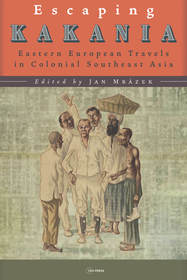
Escaping Kakania
Eastern European Travels in Colonial Southeast Asia
- Publisher's listprice GBP 133.00
-
63 540 Ft (60 515 Ft + 5% VAT)
The price is estimated because at the time of ordering we do not know what conversion rates will apply to HUF / product currency when the book arrives. In case HUF is weaker, the price increases slightly, in case HUF is stronger, the price goes lower slightly.
- Discount 20% (cc. 12 708 Ft off)
- Discounted price 50 833 Ft (48 412 Ft + 5% VAT)
- Discount is valid until: 31 December 2025
Subcribe now and take benefit of a favourable price.
Subscribe
63 540 Ft

Availability
Estimated delivery time: Expected time of arrival: end of January 2026.
Not in stock at Prospero.
Why don't you give exact delivery time?
Delivery time is estimated on our previous experiences. We give estimations only, because we order from outside Hungary, and the delivery time mainly depends on how quickly the publisher supplies the book. Faster or slower deliveries both happen, but we do our best to supply as quickly as possible.
Product details:
- Edition number 1
- Publisher Central European University Press
- Date of Publication 30 April 2024
- ISBN 9789633866658
- Binding Hardback
- No. of pages374 pages
- Size 229x152 mm
- Weight 850 g
- Language English
- Illustrations 40 b&w illus. Illustrations, black & white 541
Categories
Short description:
Escaping Kakania is about fascinating characters?soldiers, doctors, scientists, writers, painters?who traveled from their eastern European homelands to colonial Southeast Asia.
MoreLong description:
Escaping Kakania is about fascinating characters?soldiers, doctors, scientists, writers, painters?who traveled from their eastern European homelands to colonial Southeast Asia. Their stories are told by experts on different countries in the two regions, who bring diverse approaches into a conversation that crosses disciplinary and national borders.
The 14 chapters deal with the diverse encounters of eastern Europeans with the many faces of colonial southeast Asia. Some essays directly engage with post-colonial studies, contributing to an ongoing critical re-evaluation of eastern European ?semi-peripheral? (non-)involvement in colonialism. Other chapters disclose a range of perspectives and narratives that illuminate the plurality of the travelers? positions while reflecting on the specificity of the eastern European experience.
The travellers moved?as do the chapter authors?between two regions that are off-centre, in-between, shiftingly ?Eastern,? and disorientingly heterogeneous, thus complicating colonial and postcolonial notions of ?Europe,? ?East,? and East-West distinctions. Both at home and overseas, they navigated among a multiplicity of peoples, ?races,? and empires, Occidents and Orients, fantasies of the Self and the Other, adopting/adapting/mimicking/rejecting colonialist identities and ideologies. They saw both eastern Europe and southeast Asia in a distinctive light, as if through each other?and so will the readers of Escaping Kakania.
MoreTable of Contents:
Acknowledgements, Introductory (Dis)Orientation, 1. The Dutch East Indies in the Eyes of a Pole, 2. A Czech Army Doctor in Sumatra, 3. The First Impressions of Singapore in Serbian Literature , 4. Julian Fa?at in Southeast Asia, 5. Colonialism, Freedom Fighters and the Polish Ambiguity, 6. The Fate of the Birds of Paradise, 7. Ethnic Comparisons in Travelogues about Southeast Asia by Poles and Serbs of Austro-Hungarian Background, 1869-1914, 8. The Polish Botanist Marian Raciborski and his 1901 Wayang Kulit Performance, 9. The Identity of the Strange, 10. Islands of Paradise? Java and Bali Through a Woman's Eyes, 11. Indochina's Deadly Sun, 12. Czechoslovaks in Singapore and Malaya in the Interwar Period, 13. Unaware Colonialism Meets Empathy and Insightfulness, 14. Double vision, Contributors, Index
More
