

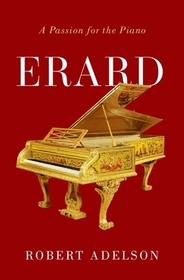
Erard
A Passion for the Piano
- Publisher's listprice GBP 81.00
-
38 697 Ft (36 855 Ft + 5% VAT)
The price is estimated because at the time of ordering we do not know what conversion rates will apply to HUF / product currency when the book arrives. In case HUF is weaker, the price increases slightly, in case HUF is stronger, the price goes lower slightly.
- Discount 10% (cc. 3 870 Ft off)
- Discounted price 34 828 Ft (33 170 Ft + 5% VAT)
Subcribe now and take benefit of a favourable price.
Subscribe
38 697 Ft

Availability
printed on demand
Why don't you give exact delivery time?
Delivery time is estimated on our previous experiences. We give estimations only, because we order from outside Hungary, and the delivery time mainly depends on how quickly the publisher supplies the book. Faster or slower deliveries both happen, but we do our best to supply as quickly as possible.
Product details:
- Publisher OUP USA
- Date of Publication 3 August 2021
- ISBN 9780197565315
- Binding Hardback
- No. of pages258 pages
- Size 221x150x38 mm
- Weight 680 g
- Language English
- Illustrations 19 figures 184
Categories
Short description:
Erard: A Passion for the Piano shows how the Erard piano played an important and often leading role in the history of the instrument, beginning in the late eighteenth century and continuing into the final decades of the nineteenth.
MoreLong description:
Sébastien Erard's (1752-1831) inventions have had an enormous impact on instruments and musical life and are still at the foundation of piano building today. Drawing on an unusually rich set of archives from both the Erard firm and the Erard family, author Robert Adelson shows how the Erard piano played an important and often leading role in the history of the instrument, beginning in the late eighteenth century and continuing into the final decades of the nineteenth.
The Erards were the first piano builders in France to prioritise the more sonorous grand piano, sending gifts of their new model to both Haydn and Beethoven. Erard's famous double-escapement action, which improved the instrument's response while at the same time producing a more powerful tone, revolutionised both piano construction and repertoire. Thanks to these inventions, the Erard firm developed close relationships with the greatest pianist composers of the nineteenth century, including Hummel, Liszt, Moscheles and Mendelssohn. The book also presents new evidence concerning Pierre Erard's homosexuality, which helps us to understand his reluctance to found a family to carry on the Erard tradition, a reluctance that would spell the end of the golden era of the firm and lead to its eventual demise. The book closes with the story of Pierre's widow Camille, who directed the firm from 1855 until 1889. Her influential position in the male-dominated world of instrument building was unique for a woman of her time.
The infusion of new perspectives and insights into the lives of the Erard brothers and their immediate family does much to position Adelson's new book as a meaningful and valuable contribution to Erard scholarship...Adelson's book, meticulously researched, is an accessible and enticing chronicling of the Erard family and their firm's history. Integrating the contents of a previously undiscovered archive with an already sizeable body of documentary evidence is no small feat. Adelson has produced a work that is deeply informative, yet flows with ease. With this wide appeal, it stands to become the go to volume for gaining understanding of the people and pianos behind the formidable Erard firm.
Table of Contents:
Figures
Abbreviations
Editorial note
Erard family tree
Introduction
Acknowledgements
1. Making a harpsichord sound like a piano
2. Founding a workshop
3. Square pianos and piano-organs
4. A modern business
5. Harps, the Revolution and London
6. The French grand piano
7. Gifts for Haydn, Beethoven and many others
8. Financial struggles
9. Faster and louder: the double-escapement action
10. Liszt and the introduction of the new piano
11. Piano wars
12. Family strains and secrets
13. Mendelssohn and the Erards
14. Passing the flame
15. Camille Erard and the end of the Erard Empire
Afterword
Notes
Bibliography

