

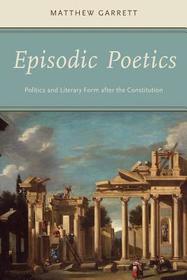
Episodic Poetics
Politics and Literary Form after the Constitution
- Publisher's listprice GBP 36.49
-
16 475 Ft (15 690 Ft + 5% VAT)
The price is estimated because at the time of ordering we do not know what conversion rates will apply to HUF / product currency when the book arrives. In case HUF is weaker, the price increases slightly, in case HUF is stronger, the price goes lower slightly.
- Discount 10% (cc. 1 648 Ft off)
- Discounted price 14 827 Ft (14 121 Ft + 5% VAT)
Subcribe now and take benefit of a favourable price.
Subscribe
16 475 Ft

Availability
printed on demand
Why don't you give exact delivery time?
Delivery time is estimated on our previous experiences. We give estimations only, because we order from outside Hungary, and the delivery time mainly depends on how quickly the publisher supplies the book. Faster or slower deliveries both happen, but we do our best to supply as quickly as possible.
Product details:
- Publisher OUP USA
- Date of Publication 28 June 2018
- ISBN 9780190887445
- Binding Paperback
- No. of pages244 pages
- Size 231x155x17 mm
- Weight 358 g
- Language English 0
Categories
Short description:
The early United States was a culture of the episode. In Episodic Poetics, Matthew Garrett merges narrative theory with social and political history to explain the early American fascination with the episodic, piecemeal plot.
MoreLong description:
The early United States was a culture of the episode. In Episodic Poetics, Matthew Garrett merges narrative theory with social and political history to explain the early American fascination with the episodic, piecemeal plot.
Since Aristotle's Poetics, the episode has been a vexed category of literary analysis, troubling any easy view of the subsumption of unwieldy narrative parts into well-plotted wholes. Garrett puts forward a new, dialectical theory of episodic form to recast this peculiar object of literary history, looking to the episode as a narrative unit smaller than the genre in order to give an account of all the period's major prose genres. Garrett shows how, in ways both magisterial and mundane, episodic forms gave variegated shape to the social, political, and economic conflicts that defined the moment of national formation.
Episodic Poetics proposes a new method of reading and a new way of conceiving of literary history. The book asks how we might understand the cultural role of the episode as a literary micro-unit, one that forces us to read individual narratives in terms of an always partial and fraught development toward plot. Episodic Poetics combines theoretical reflection and historical rigor with careful readings of texts from the early American canon such as The Federalist, Benjamin Franklin's Autobiography, and the novels of Charles Brockden Brown, along with hitherto understudied texts and ephemera such as Washington Irving's Salmagundi, Susanna Rowson's Trials of the Human Heart and the memoirs of the metalworker and failed entrepreneur John Fitch. Garrett recounts literary history not as the easy victory of grand nationalist ambitions, but rather as a series of social struggles expressed through writers' recurring engagement with incompletely integrated forms.
The book's theoretical commitments bear special mention because they mark its relatively unique relationship to ongoing debates about historicism and literary form. Episodic Poetics is part of the resurgence of new scholarship on aesthetics, but Marxist criticism has not been particularly popular in this work, which has tended to identify Marxism (via Jameson) with the mandates of historical contextualization. And yet, perhaps for this very
reason, the book's engagement with a range of older formalisms moves it toward a newly flexible, structural account of the form of politics.
Table of Contents:
Introduction: Reading the Episode in the Early Republic
The Episode between Part and Whole
Telemachus's Doubt: Toward a Theory of Episodic Poetics
The Whole against the Parts: Narrative Theory
From Event to Episode: Historical Poetics
The Hillock and the Mountain
Chapter One: The Poetics of Constitutional Consolidation
Complexity and Consolidation: Out of Many, One
Common and Finer: The Legacy of 1787-88
The Chain of Reading: Commerce, Episodic Poetics, Politics
Hierarchy and Literary Form 1: Commerce and Contagion
Hierarchy and Literary Form 2: Governing the Splintered Society
Hierarchy and Literary Form 3: Faction as Form
Mercantile Time and the Periodical Plot
Debt and the Rhythm of Exchange
Unreadability and Nationalism's Chain of Reading
Chapter Two: The Life in Episodes
Structure and Dispersion
Erratum and Episode: Duration and Narrative Binding
Character and Competition, Success and Failure
Society, Mischief, and the Episode
Experience, Selection, and Narrative Unity
Chapter Three: The Fiction of Hesitation
Reading the Episode in the Novel
Adventure and Didacticism
Incipits and the Incitement to Reading: From Clarissa to Constantia
Against the Episode: Morality and Form in the Literary Market
Nothing Happens
Endless Prolixity
Episode versus Futurity
Episode and Ideology
Chapter Four: Miscellany and the Structure of Style
Commodity Writing
Whim-Whams on the Market
Criticism and the Work of the Writer
Salmagundi: An Arthrology of the Literary Miscellany
The Rejection of Reference
Volubility and Formal Compromise
Appendix to Chapter Four: Table of Contents and Collation of Salmagundi
Conclusion
Works Cited
Index

