

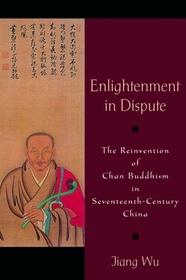
Enlightenment in Dispute
The Reinvention of Chan Buddhism in Seventeenth-Century China
- Publisher's listprice GBP 47.99
-
21 667 Ft (20 635 Ft + 5% VAT)
The price is estimated because at the time of ordering we do not know what conversion rates will apply to HUF / product currency when the book arrives. In case HUF is weaker, the price increases slightly, in case HUF is stronger, the price goes lower slightly.
- Discount 10% (cc. 2 167 Ft off)
- Discounted price 19 500 Ft (18 572 Ft + 5% VAT)
Subcribe now and take benefit of a favourable price.
Subscribe
21 667 Ft

Availability
Uncertain availability. Please turn to our customer service.
Why don't you give exact delivery time?
Delivery time is estimated on our previous experiences. We give estimations only, because we order from outside Hungary, and the delivery time mainly depends on how quickly the publisher supplies the book. Faster or slower deliveries both happen, but we do our best to supply as quickly as possible.
Product details:
- Publisher OUP USA
- Date of Publication 24 April 2008
- ISBN 9780195333572
- Binding Hardback
- No. of pages480 pages
- Size 243x162x35 mm
- Weight 842 g
- Language English
- Illustrations 21 b&w halftones 0
Categories
Short description:
Enlightenment in Dispute is the first comprehensive study of the revival of Chan Buddhism in seventeenth-century China. Focusing on the evolution of a series of controversies about Chan enlightenment, Jiang Wu describes the process by which Chan reemerged as the most prominent Buddhist establishment of the time. He argues that the revival of Chan Buddhism depended upon reinventions of previous Chan ideals, which had been largely lost after the Song dynasty. By
examining the role of textual practice and the implication of dharma transmission in rebuilding Chan institutions, Wu argues that the Chan revival was actively coordinated to coincide with the transformation of Chinese culture and society. His study concludes by bringing the Chan revival to a larger
historical context and reflecting on its legacies, ultimately establishing a general pattern of past Buddhist revivals.
Long description:
Enlightenment in Dispute is the first comprehensive study of the revival of Chan Buddhism in seventeenth-century China. Focusing on the evolution of a series of controversies about Chan enlightenment, Jiang Wu describes the process by which Chan reemerged as the most prominent Buddhist establishment of the time. He argues that the revival of Chan Buddhism depended upon reinventions of previous Chan ideals, which had been largely lost after the Song dynasty. Wu
investigates the development of Chan Buddhism in the seventeenth century through the lens of a series of controversies involving such issues as correct practice and questions of lineage and lines of transmission. Through them, he shows how the Chan revival reshaped Chinese Buddhism in late imperial China
and resonates in modern Chinese Buddhism. Situating the controversies and the rise of Chan Buddhism in the historical background of the Ming-Qing transition, Wu points out that the rise and fall of Chan Buddhism was conditioned by the transformation of Chinese culture and society. By examining the role of textual practice and the implication of dharma transmission in rebuilding Chan institutions, Wu argues that the Chan revival was actively coordinated to coincide with the transformation of
Chinese culture and society. His study concludes by bringing the Chan revival to a larger historical context and reflecting on its legacies, ultimately establishing a general pattern of past Buddhist revivals.
Enlightenment in Dispute stands as an invaluable resource for further scholarly exploration of seventeenth-century Buddhist traditions.
Table of Contents:
Introduction
Part I: The Context of Seventeenth-Century China
Chapter 1. Re-envisioning Buddhism in the Late Ming
Chapter 2. Literati and Chan Buddhism
Chapter 3. The Rise of Chan Buddhism
Part II: The Principle of Chan
Chapter 4. Clashes among Enlightened Minds
Chapter 5. The Divergence of Interpretation
Chapter 6. The Yongzheng Emperor and Imperial Intervention
Part III: Lineage Matters
Chapter 7. The Debate about Tianhuang Daowu and Tianwang Daowu in the Late Ming
Chapter 8. The Lawsuit about Feiyin Tongrongs Wudeng yantong
Chapter 9. The Aftermath
Part IV: Critical Analysis
Chapter 10. Explaining the Rise and Fall of Seventeenth-century Chan Buddhism
Chapter 11. The Pattern of Buddhist Revival in the Past
Concluding Remarks
Appendix 1. Translation of Official Documents "
Appendix 2. Major Controversies in the Seventeenth Century
Appendix 3. Survey of Evidence Concerning the Issue of Two Daowus
References
Glossary
Dictionaries and Collections
Bibliography

