

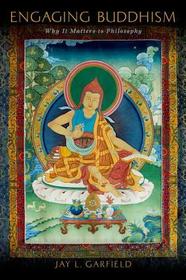
Engaging Buddhism
Why It Matters to Philosophy
- Publisher's listprice GBP 142.50
-
64 338 Ft (61 275 Ft + 5% VAT)
The price is estimated because at the time of ordering we do not know what conversion rates will apply to HUF / product currency when the book arrives. In case HUF is weaker, the price increases slightly, in case HUF is stronger, the price goes lower slightly.
- Discount 10% (cc. 6 433 Ft off)
- Discounted price 57 905 Ft (55 148 Ft + 5% VAT)
Subcribe now and take benefit of a favourable price.
Subscribe
64 338 Ft

Availability
printed on demand
Why don't you give exact delivery time?
Delivery time is estimated on our previous experiences. We give estimations only, because we order from outside Hungary, and the delivery time mainly depends on how quickly the publisher supplies the book. Faster or slower deliveries both happen, but we do our best to supply as quickly as possible.
Product details:
- Publisher OUP USA
- Date of Publication 12 February 2015
- ISBN 9780190204334
- Binding Hardback
- No. of pages400 pages
- Size 163x239x25 mm
- Weight 734 g
- Language English
- Illustrations 10 0
Categories
Short description:
This is a book for scholars of Western philosophy who wish to engage with Buddhist philosophy, or who simply want to extend their philosophical horizons. It is also a book for scholars of Buddhist studies who want to see how Buddhist theory articulates with contemporary philosophy.
MoreLong description:
This is a book for scholars of Western philosophy who wish to engage with Buddhist philosophy, or who simply want to extend their philosophical horizons. It is also a book for scholars of Buddhist studies who want to see how Buddhist theory articulates with contemporary philosophy. Engaging Buddhism: Why it Matters to Philosophy articulates the basic metaphysical framework common to Buddhist traditions. It then explores questions in metaphysics, the philosophy of mind, phenomenology, epistemology, the philosophy of language and ethics as they are raised and addressed in a variety of Asian Buddhist traditions. In each case the focus is on philosophical problems; in each case the connections between Buddhist and contemporary Western debates are addressed, as are the distinctive contributions that the Buddhist tradition can make to Western discussions. Engaging Buddhism is not an introduction to Buddhist philosophy, but an engagement with it, and an argument for the importance of that engagement. It does not pretend to comprehensiveness, but it does address a wide range of Buddhist traditions, emphasizing the heterogeneity and the richness of those traditions. The book concludes with methodological reflections on how to prosecute dialogue between Buddhist and Western traditions.
"Garfield has a unique talent for rendering abstruse philosophical concepts in ways that make them easy to grasp. This is an important book, one that can profitably be read by scholars of Western and non-Western philosophy, including specialists in Buddhist philosophy. This is in my estimation the most important work on Buddhist philosophy in recent memory. It covers a wide range of topics and provides perhaps the clearest analysis of some core Buddhist ideas to date. This is landmark work. I think it's the best cross-cultural analysis of the relevance of Buddhist thought for contemporary philosophy in the present literature. "-C. John Powers, Professor, School of Culture, History & Language, Australian National University
Table of Contents:
Acknowledgements
Preface
1. What is Buddhist Philosophy?
2. The Metaphysical Perspective I: Interdependence and Impermanence
3. The Metaphysical Perspective II: Emptiness
4. The Self
5. Consciousness
6. Phenomenology
7. Epistemology
8. Logic and the Philosophy of Language
9. Ethics
10. Methodological Postscript
References
Index

