

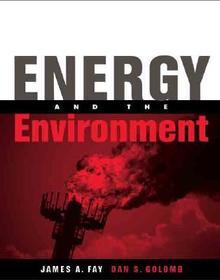
Energy and the Environment
Series: MIT-Pappalardo Series in Mechanical Engineering;
- Publisher's listprice GBP 51.99
-
23 473 Ft (22 355 Ft + 5% VAT)
The price is estimated because at the time of ordering we do not know what conversion rates will apply to HUF / product currency when the book arrives. In case HUF is weaker, the price increases slightly, in case HUF is stronger, the price goes lower slightly.
- Discount 10% (cc. 2 348 Ft off)
- Discounted price 21 125 Ft (20 120 Ft + 5% VAT)
Subcribe now and take benefit of a favourable price.
Subscribe
23 473 Ft

Availability
Out of print
Why don't you give exact delivery time?
Delivery time is estimated on our previous experiences. We give estimations only, because we order from outside Hungary, and the delivery time mainly depends on how quickly the publisher supplies the book. Faster or slower deliveries both happen, but we do our best to supply as quickly as possible.
Product details:
- Publisher Oxford University Press
- Date of Publication 21 March 2002
- ISBN 9780195150926
- Binding Hardback
- No. of pages336 pages
- Size 244x195x21 mm
- Weight 780 g
- Language English
- Illustrations numerous line figures and halftones 0
Categories
Short description:
This is a textbook for upper level undergraduate and first year graduate students, as well as professionals in the fields of energy and environmental sciences and technology. The text develops the scientific and technological background for understanding how rapidly growing use of energy threatens the degraduation of the natural environment at local, regional, and global scales. Also detailed are the newer technological developments that can mitigate these environmental effects,
especially electric power and transportation industries. This book aims to equip engineering and science majors and professionals with the basic factual knowledge needed to develope solutions to theses environmental problems.
Long description:
In an age of mounting energy crises, James A. Fay and Daniel Golomb's Energy and the Environment addresses a central and critical problem in urban-industrial societies: the destructive relationship between energy use and the environment. Intended for upper-level undergraduate and first-year graduate students, as well as professionals in the fields of energy and environmental sciences and technology, this ground-breaking text develops the scientific and technological
background for understanding how rapidly increasing use of energy threatens the natural environment at local, regional, and global scales. Fay describes fossil, nuclear, and renewable energy technologies and their effectiveness in transforming the source of energy to useful mechanical or electrical power. Special
emphasis is given to the generation of electric power and the use of transportation vehicles, as well as the technological improvements that increase energy efficiency and reduce air pollutant emissions. In addition, the text analyzes the source of toxic emissions to air, water, and land that arise from energy uses and their effects on environmental quality at urban and regional scales. This book aims to equip engineering and science majors and professionals with the basic factual knowledge
needed to develop solutions to these environmental problems.
Table of Contents:
Chapter 1. Energy and the Environment
Chapter 2. Global Energy Use and Supply
Chapter 3. Thermodynamic Principles of Energy Conversion
Chpater 4. Electrical Energy Generation, Transmission, and Storage
Chapter 5. Fossil Fueled Power Plants
Chapter 6. Nuclear Fueled Power Plants
Chapter 7. Renevable Energy
Chapter 8. Transportation
Chapter 9. Environmental Effects and Fossil Fuel Use
Chapter 10. Global Warming
Chapter 11. Concluding Remarks
Appendix A

