

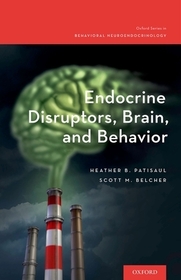
Endocrine Disruptors, Brain, and Behavior
Series: Oxford Series in Behavioral Neuroendocrinology;
- Publisher's listprice GBP 84.00
-
37 926 Ft (36 120 Ft + 5% VAT)
The price is estimated because at the time of ordering we do not know what conversion rates will apply to HUF / product currency when the book arrives. In case HUF is weaker, the price increases slightly, in case HUF is stronger, the price goes lower slightly.
- Discount 10% (cc. 3 793 Ft off)
- Discounted price 34 133 Ft (32 508 Ft + 5% VAT)
Subcribe now and take benefit of a favourable price.
Subscribe
37 926 Ft

Availability
printed on demand
Why don't you give exact delivery time?
Delivery time is estimated on our previous experiences. We give estimations only, because we order from outside Hungary, and the delivery time mainly depends on how quickly the publisher supplies the book. Faster or slower deliveries both happen, but we do our best to supply as quickly as possible.
Product details:
- Publisher OUP USA
- Date of Publication 1 June 2017
- ISBN 9780199935734
- Binding Hardback
- No. of pages270 pages
- Size 236x155x17 mm
- Weight 499 g
- Language English
- Illustrations 39 0
Categories
Short description:
Our world and bodies are becoming increasingly polluted with chemicals capable of interfering with our hormones and thus, possibly, our present and future neural and mental health. This book focuses on if and how these chemicals, known as endocrine disrupting compounds (EDCs), affect the development and function of the brain and might be contributing to neural disorders rapidly rising in prevalence. It provides an overall synthesis of the EDC field including its historical roots, major hypotheses, key findings, public health policy implications, and research gaps.
MoreLong description:
Our world and bodies are becoming increasingly polluted with chemicals capable of interfering with our hormones and thus, possibly, our present and future neural and mental health. As authors Heather Patisaul and Scott Belcher outline, there is a large lack of data and evidence in this causal relationship, which begs a need for further study to accelerate progress in the endocrinology and neuroendocrinology fields.
Endocrine Disruptors, Brain, and Behavior focuses on if and how these chemicals, known as endocrine disrupting compounds (EDCs), affect the development and function of the brain and might be contributing to neural disorders rapidly rising in prevalence. The book provides an overall synthesis of the EDC field, including its historical roots, major hypotheses, key findings, and research gaps. The authors explain why even the concept of endocrine disruption is controversial in some circles, how differing definitions of endocrine disruption and what constitutes an "adverse" outcome on the brain shape public policy, and where the current capacity by different stakeholders (industry, academia, regulatory agencies) to evaluate chemicals for safety in a regulatory context begins and ends. The book concludes with suggestions for future research needs and a summary of emerging technology which might prove capable of more effectively evaluating existing and emerging chemicals for endocrine disrupting properties. As such, it provides the context for interdisciplinary and innovative input from a broad spectrum of fields, including those well-schooled in neuroscience, evolutionary biology, brain, behavior, sex differences, and neuroendocrinology.
“Endocrine Disruptors, Brain, and Behavior is a MUST READ for basic scientists and their trainees in the fields of endocrinology and neuroendocrinology-as well as for others who want to understand the issues of 'EDCs.' Two world-class scientists-Heather Patisaul and Scott Belcher, both with national and international experience in the area-bring this very complex topic to the reader in an entirely understandable way. . . . The authors have done a remarkable job separating the science from the politics-and this is no easy task on this subject. I am deeply grateful for this scholarly and readable treatment!”-Thomas Zoeller, PhD, Professor of Biology, University of Massachusetts Amherst
Table of Contents:
Chapter 1: The Chemical Landscape
Chapter 2: Defining Endocrine Disruption
Chapter 3: Landmark EDCs of the Past and Present
Chapter 4: The Neuroendocrine System and General Mechanisms of Endocrine Disruption
Chapter 5: Receptor and Enzyme Mechanisms as Targets for Endocrine Disruptors
Chapter 6: Endocrine Disruptors and Neurobehavioral Disorders
Chapter 7: Risk Assessment and Chemical Regulatory Policy in the US and Abroad
Chapter 8: The Path Forward
Index

