

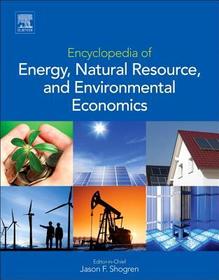
Encyclopedia of Energy, Natural Resource, and Environmental Economics
- Publisher's listprice EUR 1435.00
-
560 511 Ft (533 820 Ft + 5% VAT)
The price is estimated because at the time of ordering we do not know what conversion rates will apply to HUF / product currency when the book arrives. In case HUF is weaker, the price increases slightly, in case HUF is stronger, the price goes lower slightly.
- Discount % (cc. 0 Ft off)
- Discounted price 0 Ft (0 Ft + 5% VAT)
Subcribe now and take benefit of a favourable price.
Subscribe
560 511 Ft

Availability
Out of print
Why don't you give exact delivery time?
Delivery time is estimated on our previous experiences. We give estimations only, because we order from outside Hungary, and the delivery time mainly depends on how quickly the publisher supplies the book. Faster or slower deliveries both happen, but we do our best to supply as quickly as possible.
Product details:
- Publisher Elsevier Science
- Date of Publication 15 May 2013
- ISBN 9780123750679
- Binding Unidentified
- No. of pages1056 pages
- Size 276x215 mm
- Weight 3990 g
- Language English 0
Categories
Long description:
Every decision about energy involves its price and cost. The price of gasoline and the cost of buying from foreign producers; the price of nuclear and hydroelectricity and the costs to our ecosystems; the price of electricity from coal-fired plants and the cost to the atmosphere. Giving life to inventions, lifestyle changes, geopolitical shifts, and things in-between, energy economics is of high interest to Academia, Corporations and Governments.
For economists, energy economics is one of three subdisciplines which, taken together, compose an economic approach to the exploitation and preservation of natural resources:
- energy economics, which focuses on energy-related subjects such as renewable energy, hydropower, nuclear power, and the political economy of energy
- resource economics, which covers subjects in land and water use, such as mining, fisheries, agriculture, and forests
- environmental economics, which takes a broader view of natural resources through economic concepts such as risk, valuation, regulation, and distribution
Although the three are closely related, they are not often presented as an integrated whole. This Encyclopedia has done just that by unifying these fields into a high-quality and unique overview.
MoreTable of Contents:
Energy
- Climate change and policy
- Markets/technology innovation/adoption/diffusion
- Non-renewable Fossil/Nuclear/Electricity Markets
- Renewable/Alternative Energy
Resources
- Media non-biological
- Media: Biological
- Microeconomics
- Policy Tools
- Theoretical Tools
Environment
- Allocation Tools
- Media: policies/incentives
- Political Economy
- Valuation tools

