

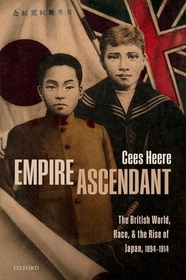
Empire Ascendant
The British World, Race, and the Rise of Japan, 1894-1914
- Publisher's listprice GBP 95.00
-
42 892 Ft (40 850 Ft + 5% VAT)
The price is estimated because at the time of ordering we do not know what conversion rates will apply to HUF / product currency when the book arrives. In case HUF is weaker, the price increases slightly, in case HUF is stronger, the price goes lower slightly.
- Discount 10% (cc. 4 289 Ft off)
- Discounted price 38 603 Ft (36 765 Ft + 5% VAT)
Subcribe now and take benefit of a favourable price.
Subscribe
42 892 Ft

Availability
printed on demand
Why don't you give exact delivery time?
Delivery time is estimated on our previous experiences. We give estimations only, because we order from outside Hungary, and the delivery time mainly depends on how quickly the publisher supplies the book. Faster or slower deliveries both happen, but we do our best to supply as quickly as possible.
Product details:
- Publisher OUP Oxford
- Date of Publication 24 December 2019
- ISBN 9780198837398
- Binding Hardback
- No. of pages238 pages
- Size 237x161x22 mm
- Weight 522 g
- Language English
- Illustrations 12 black & white illustrations 0
Categories
Short description:
In a fresh study of the Anglo-Japanese alliance, Heere examines how the British imperial system wrestled with Japan's unique status as an Asian power. Empire Ascendant combines the study of diplomacy with issues of cultural representation, race, migration, and inter-imperial relations.
MoreLong description:
In 1902, the British government concluded a defensive alliance with Japan, a state that had surprised much of the world with its sudden rise to prominence. For the next two decades, the Anglo-Japanese alliance would hold the balance of power in East Asia, shielding Japan as it cemented its regional position, and allowing Britain to concentrate on meeting the German challenge in Europe. Yet it was also a relationship shaped by its contradictions.
Empire Ascendant examines how officials and commentators across the British imperial system wrestled with the implications of Japan's unique status as an Asian power in an international order dominated by European colonial empires. On the settlement frontiers of Australasia and North America, white colonial elites formulated their own responses to the growth of Japan's power, charged by the twinned forces of colonial nationalism and racial anxiety, as they designed immigration laws to exclude Japanese migrants, developed autonomous military and naval forces, and pressed Britain to rally behind their vision of a 'white empire'. Yet at the same time, the alliance legitimised Japan's participation in great-power diplomacy, and worked to counteract racist notions of a 'yellow peril'.
By the late 1900s, Japan stood at the centre of a series of escalating inter-imperial disputes over foreign policy, defence, migration, and ultimately, over the future of the British imperial system itself. This account weaves together studies of diplomacy, strategy, and imperial relations to pose searching questions about how Japan's entry into the 'family of civilised nations' shaped, and was shaped by, ideologies of race.
Table of Contents:
Abbreviations
Note on Names and Style
Introduction
The Englands of East and West: Britain, Japan, Empire, and Race, 1894-1904
A War for Civilisation: The Russo-Japanese War, 1904-1905
'The Inalienable Right of the White Man': Contact and Competition in China
Empire and Exclusion: The Japanese 'Immigration Crisis'
The Pacific Problem: Race, Nationalism, and Imperial Defence
Alliance and Empire: British Policy and the 'Japanese Question', 1911-1914
Conclusion
Bibliography

