

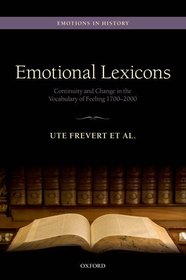
Emotional Lexicons
Continuity and Change in the Vocabulary of Feeling 1700-2000
Series: Emotions In History;
- Publisher's listprice GBP 145.00
-
65 467 Ft (62 350 Ft + 5% VAT)
The price is estimated because at the time of ordering we do not know what conversion rates will apply to HUF / product currency when the book arrives. In case HUF is weaker, the price increases slightly, in case HUF is stronger, the price goes lower slightly.
- Discount 10% (cc. 6 547 Ft off)
- Discounted price 58 921 Ft (56 115 Ft + 5% VAT)
Subcribe now and take benefit of a favourable price.
Subscribe
65 467 Ft

Availability
printed on demand
Why don't you give exact delivery time?
Delivery time is estimated on our previous experiences. We give estimations only, because we order from outside Hungary, and the delivery time mainly depends on how quickly the publisher supplies the book. Faster or slower deliveries both happen, but we do our best to supply as quickly as possible.
Product details:
- Publisher OUP Oxford
- Date of Publication 13 February 2014
- ISBN 9780199655731
- Binding Hardback
- No. of pages300 pages
- Size 241x163x24 mm
- Weight 608 g
- Language English 0
Categories
Short description:
The first cultural history of terms of emotion found in German, French, and English language encyclopaedias since the late seventeenth century.
MoreLong description:
Emotions are as old as humankind. But what do we know about them and what importance do we assign to them? Emotional Lexicons is the first cultural history of terms of emotion found in German, French, and English language encyclopaedias since the late seventeenth century. Insofar as these reference works formulated normative concepts, they documented shifts in the way the educated middle classes were taught to conceptualise emotion by a literary medium targeted specifically to them. As well as providing a record of changing language use (and the surrounding debates), many encyclopaedia articles went further than simply providing basic knowledge; they also presented a moral vision to their readers and guidelines for behaviour. Implicitly or explicitly, they participated in fundamental discussions on human nature: Are emotions in the mind or in the body? Can we "read" another person's feelings in their face? Do animals have feelings? Are men less emotional than women? Are there differences between the emotions of children and adults? Can emotions be "civilised"? Can they make us sick? Do groups feel together? Do our emotions connect us with others or create distance? The answers to these questions are historically contingent, showing that emotional knowledge was and still is closely linked to the social, cultural, and political structures of modern societies.
Emotional Lexicons analyses European discourses in science, as well as in broader society, about affects, passions, sentiments, and emotions. It does not presume to refine our understanding of what emotions actually are, but rather to present the spectrum of knowledge about emotion embodied in concepts whose meanings shift through time, in order to enrich our own concept of emotion and to lend nuances to the interdisciplinary conversation about them.
a comprehensive, rigorously compiled and wide-ranging set of resources for anyone interested in how emotions are described and conveyed.
Table of Contents:
Defining Emotions: Concepts and Debates over Three Centuries
Topographies of Emotion
Showing Emotions, Reading Emotions
The 'Origin' of Emotions - Sensitive Humans, Sensitive Animals
Healing Emotions
Age(ing) with Feeling
Felt Distances
Social Emotions
Civility and Barbarism: Emotions as Criteria of Difference
Emotional Knowledge - Modern Developments

