

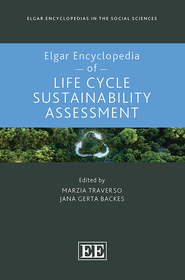
Elgar Encyclopedia of Life Cycle Sustainability Assessment
Series: Elgar Encyclopedias in the Social Sciences series;
- Publisher's listprice GBP 315.00
-
142 222 Ft (135 450 Ft + 5% VAT)
The price is estimated because at the time of ordering we do not know what conversion rates will apply to HUF / product currency when the book arrives. In case HUF is weaker, the price increases slightly, in case HUF is stronger, the price goes lower slightly.
- Discount 10% (cc. 14 222 Ft off)
- Discounted price 128 000 Ft (121 905 Ft + 5% VAT)
Subcribe now and take benefit of a favourable price.
Subscribe
142 222 Ft

Availability
Estimated delivery time: In stock at the publisher, but not at Prospero's office. Delivery time approx. 3-5 weeks.
Not in stock at Prospero.
Why don't you give exact delivery time?
Delivery time is estimated on our previous experiences. We give estimations only, because we order from outside Hungary, and the delivery time mainly depends on how quickly the publisher supplies the book. Faster or slower deliveries both happen, but we do our best to supply as quickly as possible.
Product details:
- Publisher Edward Elgar Publishing
- Date of Publication 31 July 2026
- ISBN 9781035309887
- Binding Hardback
- No. of pages744 pages
- Size 244x169 mm
- Weight 1392 g
- Language English 700
Categories
Short description:
The Elgar Encyclopedia of Life Cycle Sustainability Assessment provides concise and authoritative information on the methods, standards, and best practices in sustainability assessment.
MoreLong description:
The Elgar Encyclopedia of Life Cycle Sustainability Assessment provides concise and authoritative information on the methods, standards, and best practices in sustainability assessment.
The Encyclopedia promotes the use of standardized language in order to ensure the successful interdisciplinary implementation of Life Cycle Sustainability Assessment (LCSA). It systematically defines both fundamental and advanced terms, including sustainable development goals, characterization factors, and photochemical ozone creation potential, addressing the challenges of consistent application and interdisciplinary communication within sustainability assessment frameworks. Entries enable terms, indicators, and methods to be uniformly understood and applied across sectors, regions, and disciplines to ensure transparency and comparability in the field.
This work is an essential resource for scholars and students of economics, geography, and sociology, particularly those interested in sustainability and the environment. It is also highly beneficial for practitioners and policymakers seeking a harmonized understanding of life cycle sustainability assessment.
Key Features:
- Includes 192 entries from leading international authors
- Presents information in an accessible and engaging manner
- Provides thematic depth and further reading for subject experts
- Represents an important milestone for defining and referencing terms in the sustainability assessment of product lifecycles
‘These descriptions of a comprehensive list of methods and practices in environmental, economic, and social assessments will be a useful reference in research and in the classroom.’
Table of Contents:
Contents
Preface xii
List of contributors xiv
1 Abiotic depletion potential 1
Marco Jabara and Alessandro
Manzardo
2 Acidification potential 5
Zaid Hashash
3 Attributional life cycle assessment 8
Andrea Paulillo
4 Benchmarking 12
Mauro Cordella
5 Biodiversity loss 14
Tobias Hatzfeld and Christoph Scope
6 Carbon footprint 17
Stephan Krinke and Yu-Yi Lin
7 Characterisation factors 19
Bo P. Weidema
8 Child labor subcategory 21
Grazia Chiara Elmo
9 Children stakeholder category 25
Grazia Chiara Elmo
10 Circular economy 29
Kathrin Greiff, Berfin Bayram, and Wiebke Hagedorn
11 Circularity 32
Kathrin Greiff, Berfin Bayram, and Wiebke Hagedorn
12 Classification 36
Bo P. Weidema
13 Climate change 39
Stephan Krinke and Yu-Yi Lin
14 Closed loop 42
Giuseppe Ioppolo
15 CML 2002 method 47
Pamela Haverkamp
16 Co-product handling 50
Bo P. Weidema
17 Completeness check 53
Tobias Hatzfeld
18 Consequential life cycle assessment 55
Sara Toniolo and Carlo Ingrao
19 Consistency check 59
Tobias Hatzfeld
20 Consumer health and safety subcategory 63
Rose Nangah Mankaa
21 Consumer stakeholder category 66
Joana Fedato Pogoda
22 Corporate carbon footprint 69
Peter Saling
23 Corporate social responsibility 74
Rupert J. Baumgartner, JosefPeter Schöggl, and Martina Zimek
24 Corporate sustainability 78
Peter Saling
25 Corruption subcategory 82
Monica Serreli
26 Cost in life cycle costing 86
Christoph Scope
27 Cradle to Cradle 89
Andrea Paulillo
28 Cradle to Gate 94
Andrea Paulillo
29 Cradle to Grave 96
Andrea Paulillo
30 Critical resources 99
Gian Andrea Blengini
31 Critical review 103
Atsushi Inaba
32 Cultural heritage subcategory 106
Monika Cera
33 Cumulative energy demand 110
Saverio De Franceschi,
Junzhang Wu, Alessandro Manzardo, and Nils Pauliks
34 Cut-off criteria 114
Atsushi Inaba
35 Data integration 117
Caroline Visentin
36 Data quality distance 121
Caroline Visentin
37 Data quality goals 125
Caroline Visentin
38 Data quality indicators 129
Caroline Visentin
39 Data variability 133
Caroline Visentin
40 Life cycle sustainability assessment for decision-making 137
Luoqin Liu, Alessandro Manzardo, and Junzhang Wu
41 Decision support 143
Miguel Brandão
42 Delocalization and migration 146
Rohit Ravi
43 Downcycling 150
Lucia Rigamonti
44 Downstream 154
Giulia Cavenago and Lucia Rigamonti
45 Dynamic life cycle sustainability assessment 158
Hashem Amini Toosi
46 Ecodesign 162
Mauro Cordella
47 Eco-efficiency 164
Sarina Achterfeldt
48 Ecoinvent 169
Gabriella Buttitta and Davide Lo Presti
49 Economic allocation 173
Bo P. Weidema
50 Input-Output Models in Life Cycle Sustainability Assessment 175
Amaro O. Pereira Jr, Sandra Venghaus, Joilson A. Cabral,
Paulo V.S. Lima, Matheus A. Santos, Holger Schlör, Sally Springer, Johannes Többen,
Stefan Vögele, and Petra Zapp
51 Ecosystem 179
Christina Wulf, Petra Zapp, and Sally Springer
52 Ecosystem quality 181
Christina Wulf
53 Ecotoxicity potential including terrestrial and marine/aquatic potential 184
Monu George Varghese
54 Education in the local community subcategory 190
Rohit Ravi
55 Elementary flow 194
Benedetto Rugani
56 Employment relationship subcategory 197
Gijs Krekel
57 End-of-life 200
Anna Luthin
58 Endpoint impact category 204
Andrea Paulillo
59 Energy 208
Clemens Mostert
60 Environmental assessment 211
Yahong Dong and Md Uzzal Hossain
61 Environmental footprint 217
Yahong Dong and Md Uzzal Hossain
62 Environmental hotspot analysis 223
Nicholas M. Holden
63 Environmental impact 227
Yahong Dong and Md Uzzal Hossain
64 Life cycle impact assessment 234
Roberto Rosa, Carlo Ingrao, and Anna Maria Ferrari
65 Environmental impact category 240
Suzana Ostojic
66 Environmental input–output model 245
Masaharu Motoshita and Maeno Keitaro
67 Environmental Kuznets curve 247
Mario Grosso
68 Environmental management 250
Yahong Dong and Md Uzzal Hossain
69 Environmental product declaration 256
Pamela Haverkamp
70 Environmental responsibility 260
Mario Grosso
71 Environmental sustainability 264
Yahong Dong and Md Uzzal Hossain
72 Equal opportunities: Discrimination impact subcategory 271
Arij Chabrawi
73 Eutrophication potential 274
Jinhui Zhou
74 Exposure assessment method 278
Masaharu Motoshita and Kamrul Islam
75 Externalities 282
Hashem Amini Toosi
76 Fair competition subcategory 285
Bruna Pereira de Souza
77 Fair salary subcategory 288
Sabrina Neugebauer
78 Feedback mechanism subcategory 293
Gijs Krekel
79 Forced labour 295
Arij Chabrawi
80 Foreground/background process 298
Gabriella Buttitta and Davide Lo Presti
81 Freedom of association and collective bargaining subcategory 303
Bianca Maria Tragnone and Luigia Petti
82 Freshwater aquatic ecotoxicity potential 307
Mario Grosso and Stefano Puricelli
83 Functional unit 312
Benedetto Rugani
84 Global warming potential 315
Stephan Krinke and Yu-Yi Lin
85 Goal and scope phase 318
Jana Gerta Backes
86 Greenhouse gas emissions 321
Stephan Krinke and Yu-Yi Lin
87 Health issues for children as consumers subcategory 324
Bruna Pereira de Souza
88 Human toxicity potential 327
Olubukola Tokede
89 Hybrid life cycle assessment 333
Nicholas M. Holden
90 Impact pathway 337
Bo P. Weidema
91 Industrial metabolism 341
Nicholas M. Holden
92 Input–output analysis 345
Saroj Kumar Chapagain and Edeltraud Guenther
93 Input–output 347
Patrick Haun
94 Integrated assessment model 350
Nicholas M. Holden
95 Interpretation 353
Jana Gerta Backes
96 Inventory analysis 357
Petra Zapp, Sally Springer, and Christina Wulf
97 Life cycle and life cycle perspective 360
David Hysi
98 Life cycle assessment 363
David Hysi
99 Life cycle costing 366
Anna Luthin
100 Life cycle crowns 370
Blanca Corona
101 Life cycle impact assessment 373
Roland Meyer
102 Life cycle interpretation 377
Blanca Corona
103 Life cycle inventory 382
Umberto Arena, Filomena Ardolino, and Francesco Parrillo
104 Life cycle sustainability assessment 388
Jana Gerta Backes
105 Life cycle thinking 392
Blanca Corona
106 Local community 394
Zaid Hashash
107 Local employment subcategory 398
Manuela D’Eusanio
108 Marine plastic waste 401
Olubukola Tokede and Isaac Akinwumi
109 Material flow 405
Kathrin Greiff, Berfin Bayram, and Wiebke Hagedorn
110 Material flow analysis 407
Kathrin Greiff, Berfin Bayram, and Wiebke Hagedorn
111 Material footprint 410
Kathrin Greiff, Benedikt Verkic, Berfin Bayram, and Wiebke Hagedorn
112 Midpoint impact categories 414
Roland Meyer
113 Monetarization 417
Christoph Scope
114 Monte Carlo simulation 420
Antonino Marvuglia
115 Multi-criteria decision making 421
Arij Chabrawi and Bruna Pereira de Souza
116 Normalization 425
Manouchehr Shokri
117 Nutritional life cycle assessment 429
Silvia Zingale, Alba ReguantClosa, Thomas Nemecek, and Carlo Ingrao
118 Organizational life cycle assessment 437
Alexandra Weniger
119 Ozone depletion potential 440
Lukas Messmann
120 Pedigree matrix 448
Hashem Amini Toosi
121 Photochemical ozone creation potential 452
Lars Wietschel
122 Physical allocation 457
Miguel Brandão and Bo P. Weidema
123 Planetary boundaries 461
Martina Zimek, Josef-Peter Schöggl, and Rupert J. Baumgartner
124 Positive impact 468
Arij Chabrawi
125 Poverty alleviation subcategory 471
Luigia Petti and Federica Silveri
126 Prevention and mitigation of armed conflicts subcategory 476
Monika Cera
127 Product and service 480
Kamrul Islam and Masaharu Motoshita
128 Product environmental footprint 482
Pamela Haverkamp
129 Product system model 486
Kamrul Islam and Masaharu Motoshita
130 Productivity 488
Hashem Amini Toosi
131 Product social impact life cycle assessment (PSILCA) 491
Davis Jose
132 Rebound effect 494
Antonino Marvuglia
133 ReCiPe 496
Katharina Roche
134 Recycling 500
Anna Luthin
135 Recycling rate 503
Anna Luthin
136 Reference flow 506
Jana Gerta Backes
137 Reference scale approach 507
Cinzia Capitano, Antonio Covais, and Marzia Traverso
138 Resource depletion 514
Mario Grosso
139 Resource efficiency 518
Isabella Bianco
140 Respect of indigenous rights subcategory 521
Monika Cera
141 Respect of intellectual property rights subcategory 525
Luigia Petti and Bianca
Maria Tragnone
142 Safe and healthy living conditions category 529
Bernadette Sidonie Libom and Alessandro Manzardo
143 Scarcity 535
Antonino Marvuglia
144 Secure living conditions subcategory 537
Davis Jose
145 Sensitivity analysis 539
Jana Gerta Backes
146 Sexual harassment subcategory 541
Monika Cera
147 Smallholders including farmers subcategory 545
Jessica Hanafi
148 Social benefits/social security subcategory 549
Katharina Roche and Martina Zimek
149 Social footprint and handprint 553
Arij Chabrawi
150 Social hotspot 556
Gabriella Arcese
151 Social hotspot analysis 560
Davis Jose
152 Social hotspot database 563
Gabriella Arcese
153 Social impact subcategories 567
Maria Concetta Pedalà, Antonio Covais, and Marzia Traverso
154 Social indicators 572
Davis Jose
155 Social life cycle assessment 575
Alexandra Weniger
156 Social organizational life cycle assessment 578
Manuela D’Eusanio
157 Social performance measurement 583
Davis Jose
158 Social risk assessment 588
Davis Jose
159 Social sustainability 592
Sonia Valdivia, Natalia A. Cano, and Guido Sonnemann
160 Social well-being 598
Lucia Mancini
161 Society stakeholder category 602
Giuseppe Cecere and Lucia Rigamonti
162 Stakeholder 606
Lucia Mancini
163 Stakeholder analysis and involvement 610
Lucia Mancini
164 Stakeholder category 613
Lucia Mancini
165 Subcategory assessment method 616
Luigia Petti
166 Substitution 621
Miguel Brandão and Bo P. Weidema
167 Supplier relationship subcategory 626
Manuela D’Eusanio
168 Sustainability 630
Shammas Saleem, Antonio Covais, and Marzia Traverso
169 Sustainability improvement 636
Mauro Cordella
170 Sustainability indicators 638
Rose Nangah Mankaa
171 Sustainable development goals 644
Jana Gerta Backes
172 Sustainable resource extraction 649
Nils Jäger
173 System boundary 651
Pamela Haverkamp
174 Transformation 654
Nils Jäger
175 Transparency subcategory 658
Jana Gerta Backes
176 Triple bottom line 660
Olubukola Tokede and Sruthii Venkata Subaramani
177 Uncertainty 665
Roberta Salomone
178 Uncertainty analysis 669
Roberta Salomone
179 Upstream 673
Roberta Salomone
180 Urban metabolism 678
Giuseppe Ioppolo
181 Urban resource harvesting 683
Giuseppe Ioppolo
182 Use stage 687
Sally Springer, Petra Zapp, and Christina Wulf
183 USEtox 690
Rose Nangah Mankaa
184 Value chain actors 695
Roland Meyer
185 VIKOR 698
Antonino Marvuglia
186 Waste 701
Umberto Arena, Filomena Ardolino, and Francesco Parrillo
187 Water footprint 704
Markus Berger
188 Wealth distribution subcategory 707
Bruna Pereira de Souza
189 Weighting 711
Bo P. Weidema
190 Worker health and safety subcategory 715
Arij Chabrawi
191 Workers stakeholder category 718
Maria Giovina Pasca
192 Working hours subcategory 722
Maria Giovina Pasca

