

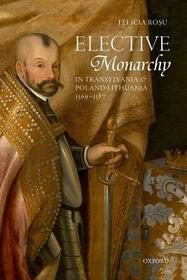
Elective Monarchy in Transylvania and Poland-Lithuania, 1569-1587
- Publisher's listprice GBP 105.00
-
47 407 Ft (45 150 Ft + 5% VAT)
The price is estimated because at the time of ordering we do not know what conversion rates will apply to HUF / product currency when the book arrives. In case HUF is weaker, the price increases slightly, in case HUF is stronger, the price goes lower slightly.
- Discount 10% (cc. 4 740 Ft off)
- Discounted price 42 667 Ft (40 635 Ft + 5% VAT)
Subcribe now and take benefit of a favourable price.
Subscribe
47 407 Ft

Availability
printed on demand
Why don't you give exact delivery time?
Delivery time is estimated on our previous experiences. We give estimations only, because we order from outside Hungary, and the delivery time mainly depends on how quickly the publisher supplies the book. Faster or slower deliveries both happen, but we do our best to supply as quickly as possible.
Product details:
- Publisher OUP Oxford
- Date of Publication 7 December 2017
- ISBN 9780198789376
- Binding Hardback
- No. of pages240 pages
- Size 242x164x22 mm
- Weight 512 g
- Language English
- Illustrations 7 black and white figures/illustrations 0
Categories
Short description:
This book examines the transformation of the elective principle in Transylvania and the newly created Polish-Lithuanian Commonwealth in the early 1570s. These countries insisted on their right to 'free elections', despite the threat to public stability, and this served to transform their institutions and constitutions.
MoreLong description:
This book is an examination of why and how the elective principle, already established in Transylvanian and Polish political culture in the late medieval period, was transformed in the early elections of the 1570s. In this period, the two polities adopted constitutional arrangements different in depth and scope but based on the same fundamental principles: elective thrones, state-sanctioned religious pluralism, and constitutional guarantees for the right of disobedience. There were important variations in their regulation and application, but Transylvania and the newly created Polish-Lithuanian Commonwealth had one essential thing in common: they were the only two polities in early modern Europe whose political systems secured the succession of their rulers through large-scale elections in which the dynastic principle, although still important, was not binding.
This excellent study illuminates the political culture of early modern elective monarchies through the examples of the Polish-Lithuanian Commonwealth and Transylvanian principality. ... Rosư has consulted a very impressive range of archival and printed sources in a variety of languages to provide a clear and authoritative account of complex terrain that will be unfamiliar to many readers.
Table of Contents:
Introduction
Choosing to Elect
Campaigning
Voting
Contract
Authority
Conclusions

