

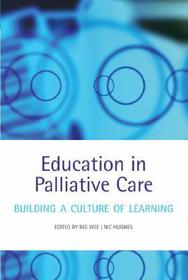
Education in Palliative Care
Building a Culture of Learning
- Publisher's listprice GBP 82.00
-
37 023 Ft (35 260 Ft + 5% VAT)
The price is estimated because at the time of ordering we do not know what conversion rates will apply to HUF / product currency when the book arrives. In case HUF is weaker, the price increases slightly, in case HUF is stronger, the price goes lower slightly.
- Discount 10% (cc. 3 702 Ft off)
- Discounted price 33 321 Ft (31 734 Ft + 5% VAT)
Subcribe now and take benefit of a favourable price.
Subscribe
37 023 Ft

Availability
printed on demand
Why don't you give exact delivery time?
Delivery time is estimated on our previous experiences. We give estimations only, because we order from outside Hungary, and the delivery time mainly depends on how quickly the publisher supplies the book. Faster or slower deliveries both happen, but we do our best to supply as quickly as possible.
Product details:
- Publisher OUP Oxford
- Date of Publication 22 February 2007
- ISBN 9780198569855
- Binding Paperback
- No. of pages376 pages
- Size 240x170x20 mm
- Weight 652 g
- Language English
- Illustrations 30 black and white line illustrations 0
Categories
Short description:
Education is key to developing a strong base for the future of palliative care, and this book provides a wide-ranging, global view of palliative care education. It offers theoretical and practical insights, along with specific suggestions for developing knowledge and skills for teaching.
MoreLong description:
Despite the fact that most palliative care educators are involved in teaching, there is little literature devoted to education specifically within palliative care. This book bridges that gap, giving a wide-ranging, global view of palliative care education. It offers theoretical and practical insights, along with specific suggestions for developing knowledge and skills for teaching. It also contains extensive accounts of important contextual matters which influence the range and quality of palliative care education, including: interprofessional learning; continuing professional development; evaluation; and educational leadership. The development of palliative care as a clinical speciality is increasingly conducted at an international level, and a special feature of this book is the inclusion of chapters reviewing palliative care education in each continent. This enables practitioners and teachers to share knowledge across diverse healthcare systems and cultures. There is also an acknowledgement of the multi-professional team involved in palliative care, as education and training are looked at from the perspectives of doctors, nurses, and allied health professionals.
The book is split into three distinct parts:
Part 1 - sets the scene for existing palliative care education, both in the UK and internationally.
Part 2 - focuses on the theory underpinning each aspect of teaching, learning and assessment, and then examines the practicalities of delivering these in the clinical setting.
Part 3 - explores ways of building and nurturing a culture of learning in palliative care, whether as an individual or as an organization.
As palliative care continue to evolve, increasingly influencing the care on non-malignant disease and reaching into different cultures around the world, this book addresses the very important question as to what are the best methods of education for palliative care...[it is] both detailed and comprehensive and would be essential reading for anyone involved with setting up or running palliative care education courses.
Table of Contents:
Introduction: learning and teaching palliative care
PART I: THE CURRENT STATE OF PALLIATIVE CARE EDUCATION
Section one: In the United Kingdom
Medical education
Nurse education
Occupational therapy, physiotherapy and social work education
Section two: In other continents
Introduction
Africa
Asia-Pacific
Australia and New Zealand
Europe
India
North America
South America
Implications for global education
PART II: LEARNING, TEACHING AND ASSESSMENT
Bedside teaching
Work-based learning
Reflective learning
Small group and one-to-one teaching
Experiential workshops
Teaching large groups
Distance learning
Assessment
Evaluation
PART III: BUILDING A CULTURE OF LEARNING IN PALLIATIVE CARE
Interprofessional education
Developing a community of teachers
Continuing professional development
Organizing education: key concepts and processes
Educational leadership

