

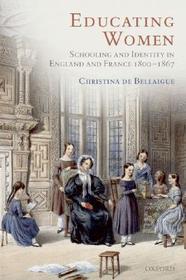
Educating Women
Schooling and Identity in England and France, 1800-1867
- Publisher's listprice GBP 115.00
-
51 922 Ft (49 450 Ft + 5% VAT)
The price is estimated because at the time of ordering we do not know what conversion rates will apply to HUF / product currency when the book arrives. In case HUF is weaker, the price increases slightly, in case HUF is stronger, the price goes lower slightly.
- Discount 10% (cc. 5 192 Ft off)
- Discounted price 46 730 Ft (44 505 Ft + 5% VAT)
Subcribe now and take benefit of a favourable price.
Subscribe
51 922 Ft

Availability
printed on demand
Why don't you give exact delivery time?
Delivery time is estimated on our previous experiences. We give estimations only, because we order from outside Hungary, and the delivery time mainly depends on how quickly the publisher supplies the book. Faster or slower deliveries both happen, but we do our best to supply as quickly as possible.
Product details:
- Publisher OUP Oxford
- Date of Publication 16 August 2007
- ISBN 9780199289981
- Binding Hardback
- No. of pages294 pages
- Size 240x163x20 mm
- Weight 643 g
- Language English
- Illustrations 6 halftones 0
Categories
Short description:
In this book, Christina de Bellaigue uses schooling for girls as a lens through which to examine the lives of women on either side of the Channel. She looks at boarding-schools for girls in nineteenth-century England, exploring the emergence and expansion of private schooling for girls, the recruitment and training of schoolmistresses; the strategies involved in establishing a school and claiming professional standing; the lives of schoolgirls, and the instruction they received; and the experiences of pupils and teachers who crossed the Channel. In the process, Educating Women illuminates unexplored areas of the history of women and of education, and uncovers new findings on the history of the professions and the relationship between gender and national identity in the nineteenth century.
MoreLong description:
An increasing number of middle class families were taking the education of their daughters seriously in the first part of the nineteenth century, and boarding-schools were multiplying on both sides of the Channel. Schoolmistresses - rarely, in fact, the 'reduced gentlewomen' of nineteenth century fiction - were not only often successful entrepreneurs, but also played an important part they played in the development of the teaching profession, and in the expansion of secondary education. Uncovering their careers and the experiences of their pupils reveals the possibilities and constraints of the lives of middle class women in England and France in the period 1800-1867.
Yet those who crossed the Channel in the nineteenth century often commented on the differences they discovered between the experiences of French and English women. Women in France seemed to participate more fully in social and cultural life than their counterparts in England. On the other hand, English girls were felt to enjoy considerably more freedom than young French women. Using the development of schooling for girls as a lens through which to examine the lives of women on either side of the Channel, Educating Women explores such contrasts. It reveals that the differences observed by contemporaries were rooted in the complex interaction of differing conceptions of the role of women with patterns of educational provision, with religion, with the state, and with differing rhythms of economic growth. Illuminating a neglected area of the history of education, it reveals new findings on the history of the professions, on the history of women and on the relationship between gender and national identity in the nineteenth century.
[A] beautifully structured book.
Table of Contents:
Introduction
The development of schooling for girls in England and France
Becoming a schoolmistress
The business of school-keeping
Teaching as a profession
Becoming a schoolgirl
Instruction
Crossing the Channel
Conclusion

