

- Publisher's listprice GBP 10.99
-
5 250 Ft (5 000 Ft + 5% VAT)
The price is estimated because at the time of ordering we do not know what conversion rates will apply to HUF / product currency when the book arrives. In case HUF is weaker, the price increases slightly, in case HUF is stronger, the price goes lower slightly.
- Discount 10% (cc. 525 Ft off)
- Discounted price 4 725 Ft (4 500 Ft + 5% VAT)
Subcribe now and take benefit of a favourable price.
Subscribe
5 250 Ft

Availability
Only to order.
Why don't you give exact delivery time?
Delivery time is estimated on our previous experiences. We give estimations only, because we order from outside Hungary, and the delivery time mainly depends on how quickly the publisher supplies the book. Faster or slower deliveries both happen, but we do our best to supply as quickly as possible.
Product details:
- Edition number 2
- Publisher OUP USA
- Date of Publication 21 September 2017
- ISBN 9780190688424
- Binding Paperback
- No. of pages248 pages
- Size 137x208x12 mm
- Weight 272 g
- Language English 0
Categories
Short description:
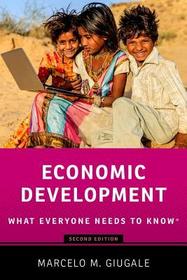
The practice of economic development has undergone significant transformation over the past decade, due to globalization and democratization. The fully revised and updated second edition of Economic Development: What Everyone Needs to Know provides a clear and concise introduction to the development problems that policy-makers, professionals, development agencies, NGOs, charities, and private citizens face.
MoreLong description:
There is much discussion about global poverty and the billions of people living with almost nothing. Why is it that governments, development banks, think-tanks, academics, NGOs and many others can't just fix the problem? Why is it that seemingly obvious reforms never happen? Why are prosperity and equity so elusive?
The revised second edition of Economic Development: What Everyone Needs to Know® brings readers right into the trenches of development policies to show what practitioners are actually doing and explains the issues, dilemmas, options, frustrations and opportunities they face, day in and day out. In straightforward language and a question-and-answer format, Marcelo M. Giugale outlines the frontier of the development practice or, as he puts it, "...the point at which knowledge stops and ignorance begins." He takes readers from why it is so difficult to get governments to function, to the basic policies that economies need to work well, the powerful new tools for social assistance, and the challenges of inclusion, education, health, infrastructure, technology, data, and foreign aid.
Giugale gives no definitive, universal answers. They don't really exist. Rather, he highlights what works, what doesn't, and what's promising. Drawing from examples across the world, his overall message is clear: economic development, and the poverty reduction that goes with it, have never been more possible for more countries.
Marcelo Giugale has written a book with a highly original style: it poses, and then answers, a series of questions, with fascinating examples on every page. Even more remarkable, it lives up to the ambitious goal proclaimed in its title: Economic Development - What Everyone Needs to Know." - George Akerlof, Nobel Laureate in Economics, 2001
Table of Contents:
Preface: Whom is this book for?
Acknowledgments
Overview: What Is Economic Development and What Does This Book Say about It?
Chapter 1: Governments: One Day, They Will Work for You
Why Do Obvious Reforms Never Happen?
How Is the Relationship between the State and the Citizen Changing?
Why Should Governments Intervene in Markets?
Has Government Decentralization Worked?
Do We Really Care about Graft?
Why Can't We Stop Conflict?
Are Natural Resources a Curse?
What Are the Signs That a Country Is Managing Its Riches Well?
Chapter 2: Economic Policy: The Basics You've Got to Get Right
Why Governments Struggle to Prop the World's Economy?
What Is Structural Reform?
What Are the G20 and Why Do They Matter for Development?
How Do Governments Regulate the Financial Sector?
Do the Fed's Decisions Matter for the Developing World?
What Do Europe's Woes Mean for the World's Poor?
How Do You Prepare for the Next Global Crisis?
Was the Commodity Bonanza Wasted?
Will Globalization End?
Why Does Growth Happen in Some Places and Not in Others?
Why Is It So Difficult to Agree on Tax Reform?
What Is the Global Tax War?
Chapter 3: Social Policy: Old War, New Weapons
Why Did Piketty's Work Pique Our Sudden Interest in Inequality?
How Many People Live in Extreme Poverty?
How Can We Help the New Poor?
Can We End Poverty?
Is There a Way to Measure Human Opportunity?
Why Are Statistics So Important in Ending Poverty?
Do We Know the Real Impact of Government Interventions?
Can Cheap Oil Hurt the Poor?
Chapter 4: Inclusion: Those Who Are Always Left Behind
Will We Ever Reach Gender Parity?
Has Globalization Helped or Hurt Women?
Impact Evaluation: A Woman's Best Friend?
How Did Average Housewives Become the Greatest Generation of Argentine Women?
Why Do the Poor Complain So Little?
Why Is Early Childhood Development So Difficult?
What Do We Know about Informal Workers?
Chapter 5: Sectors: What Ministers Will Worry about-or Should
Can Governments Create Industries?
Does Foreign Investment Help You Join Global Value Chains?
Can You Innovate Your Way out of the Middle-Income Trap?
From Miami to Mumbai: What Makes Cities Competitive?
How Will Technology Shape the World of Tomorrow's Leaders?
How Will Tomorrow's Infrastructure Be Built?
How Green Should Economic Growth Be?
Is It Time to End Fuel Subsidies?
Can Emerging Economies Have Universal Health Coverage?
How Do You Measure the Economic Impact of Ebola?
Is There New Power in Entertainment Education?
How Do You Deal with Rising Food Prices?
What Are "Commodity Super-cycles," and Why Do They Matter?
How Do Oil-rich Governments Respond to Falling Oil Prices?
Should Foreign Aid Be Abandoned?
What's the Future of Foreign Aid?
Chapter 6: Africa: The Last Frontier
Is Africa's Emergence for Real?
Can Africa Be Defragmented?
Can Africans Become Shareholders in their Own Wealth?
How Have the World's Newest Nations Fared?
Can Africa Compete with China?
Can Africa Follow China's Industrialization Path?
Can Services Drive Africa's Development?
Can Africa Feed Africa?
How Does One Fix Africa's Statistics?
Did Debt Forgiveness Work in Africa?
Concluding Thoughts
Notes
Bibliography
Index

