

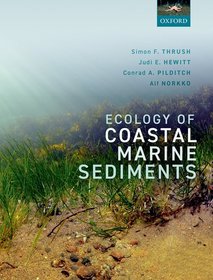
Ecology of Coastal Marine Sediments
Form, Function, and Change in the Anthropocene
- Publisher's listprice GBP 105.00
-
47 407 Ft (45 150 Ft + 5% VAT)
The price is estimated because at the time of ordering we do not know what conversion rates will apply to HUF / product currency when the book arrives. In case HUF is weaker, the price increases slightly, in case HUF is stronger, the price goes lower slightly.
- Discount 10% (cc. 4 741 Ft off)
- Discounted price 42 667 Ft (40 635 Ft + 5% VAT)
Subcribe now and take benefit of a favourable price.
Subscribe
47 407 Ft

Availability
Estimated delivery time: In stock at the publisher, but not at Prospero's office. Delivery time approx. 3-5 weeks.
Not in stock at Prospero.
Why don't you give exact delivery time?
Delivery time is estimated on our previous experiences. We give estimations only, because we order from outside Hungary, and the delivery time mainly depends on how quickly the publisher supplies the book. Faster or slower deliveries both happen, but we do our best to supply as quickly as possible.
Product details:
- Publisher OUP Oxford
- Date of Publication 12 February 2021
- ISBN 9780198804765
- Binding Hardback
- No. of pages224 pages
- Size 254x195x16 mm
- Weight 636 g
- Language English
- Illustrations 63 colour line figures and photographs 62
Categories
Short description:
This accessible textbook provides an ideal point of entry into the field, providing basic information on the nature of soft-sediment ecosystems, examples of how and why we research them, the new questions these studies inspire, and the applications that ultimately benefit society.
MoreLong description:
Marine sediments dominate the global seabed, creating the largest ecosystem on earth. Seafloor biodiversity is a key mediator of ecosystem functioning, yet critical processes are often excluded from global biogeochemical budgets or simplified to black boxes in ecosystem models.
This accessible textbook provides an ideal point of entry into the field, providing basic information on the nature of soft-sediment ecosystems, examples of how and why we research them, the new questions these studies inspire, and the applications that ultimately benefit society. While focussing on coastal habitats (<200m depth) to emphasize process-based experimental studies, it is relevant to the full range of marine sedimentary habitats. The authors describe the interactions between marine organisms and their physical and chemical environment, demonstrating the need for carefully designed research programs and providing the basic steps required to formulate sound ecological questions before applying them to empirical studies of real-world ecosystems. The book reveals the connections between different system components and drivers of change, examining how we can develop knowledge on the biodiversity and functioning of soft sediments and apply it to a better understanding of ecosystem change, human impacts, and effective restoration.
Ecology of Coastal Marine Sediments is intended for advanced undergraduate and graduate students who have completed a general ecology course but received no further training in marine science. It will also be useful to both professional researchers and resource managers in marine ecology and environmental science who seek a compact and authoritative introduction to sediment ecology.
Table of Contents:
Part I: The Environment
The sedimentary environment
Benthic animals and plants and what they do to sediments
Disturbance, patches, and mosaics
Part II: Doing Research
Design and the philosophy of sampling
Data collection methods and statistical analyses
Part III: Communities
Describing assemblages and biodiversity of sediment-living organisms
Biotic interactions
Temporal variations in benthic assemblages and processes
Part IV: Functioning
EF Ecosystem function
BEF Biodiversity-ecosystem functioning
Part V: Anthropocene
Human Impacts
Climate change and seafloor ecology
Restoration of soft-sediment habitats
Glossary

