

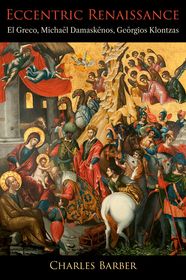
Eccentric Renaissance
El Greco, Michael Damaskenos, Georgios Klontzas
- Publisher's listprice GBP 62.00
-
27 993 Ft (26 660 Ft + 5% VAT)
The price is estimated because at the time of ordering we do not know what conversion rates will apply to HUF / product currency when the book arrives. In case HUF is weaker, the price increases slightly, in case HUF is stronger, the price goes lower slightly.
- Discount 10% (cc. 2 799 Ft off)
- Discounted price 25 194 Ft (23 994 Ft + 5% VAT)
Subcribe now and take benefit of a favourable price.
Subscribe
27 993 Ft

Availability
printed on demand
Why don't you give exact delivery time?
Delivery time is estimated on our previous experiences. We give estimations only, because we order from outside Hungary, and the delivery time mainly depends on how quickly the publisher supplies the book. Faster or slower deliveries both happen, but we do our best to supply as quickly as possible.
Product details:
- Publisher OUP USA
- Date of Publication 19 December 2024
- ISBN 9780190209001
- Binding Hardback
- No. of pages336 pages
- Size 221x155x33 mm
- Weight 567 g
- Language English
- Illustrations 160 colour photos 547
Categories
Short description:
Eccentric Renaissance shows how El Greco and two other sixteenth-century Cretan artists, Michael Damaskenos and Georgios Klontzas, actively engaged in a re-casting of the Byzantine tradition of icon painting on the Venetian colony of Crete. In so doing, they created art that articulated a point of view that was shaped outside of and against the hegemonic world of Vasari's account of art history. Building upon their own tradition, they developed a highly original understanding of the icon and explored its power to reconcile Byzantine and Renaissance styles of painting and provide a response to the growing presence of Islam.
MoreLong description:
The Byzantine icon has long remained marginal to the study of art's history, only emerging from Giorgio Vasari's condemnation of the gilded, unnatural style of Byzantine painting (maniera greca) when his theories were challenged in the early twentieth century. Eccentric Renaissance focuses on an earlier reaction to Vasari's narrative and discusses three artists who shaped distinct responses to the hegemonic sway of sixteenth-century Italian art. Domenikos Theotokopoulos (more familiarly known as El Greco), Michael Damaskenos, and Georgios Klontzas were contemporary icon painters on the Venetian colony of Crete. Trained in the rich tradition of Cretan painting, these artists differed from their forebears in asserting a self-conscious creativity in their work. They renewed the art of icon painting in the context of Venetian colonialism by reconsidering how their art might address the contemporary world.
Deemed eccentric, El Greco's work presented a Greek path contrary to the one promoted in Vasari's history of art. His was an art that was sensual, complex, and difficult. Michael Damaskenos's profound engagement with Venetian painting was mixed with traditional iconic styles, reflecting life in a colony in which Orthodox and Catholic, Greek and Venetian were fluid rather than static descriptors of the self. Georgios Klontzas used his art to confront the horrors of his day. The impending threat of the Ottoman conquest of Crete and the outbreak of plague in 1592 shaped his extraordinary manuscript, Apocalypse and History, that sought to understand these calamities in light of both divine providence and human experience. Each of these artists chose an eccentric point of departure for their work. Greek, colonized, and fearful, they invite us to look again and to look differently at the later sixteenth century.
Barber (Princeton Univ.) moves beyond his studies of the history and theory of the icon, iconoclasm, Byzantine aesthetics, and intellectual history by taking his readers on an intriguing study of what happened to the Byzantine icon as Western art advanced into 16th-century style and techniques.... Recommended.
Table of Contents:
Acknowledgments
List of Illustrations
Introduction
1. Andrea Cornaro's World
2. Domenikos Theotokopoulos' Arte Moderna alla Greca
3. Michael Damaskenos and the Poetics of Difference
4. Foreseen: Georgios Klontzas in a Plague Year
Conclusion
Bibliography
Index

