

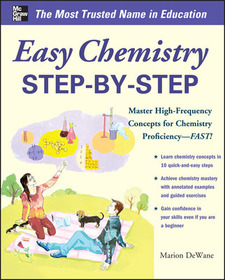
Easy Chemistry Step-by-Step
Series: Easy Step-by-Step Series;
- Publisher's listprice GBP 19.99
-
9 025 Ft (8 595 Ft + 5% VAT)
The price is estimated because at the time of ordering we do not know what conversion rates will apply to HUF / product currency when the book arrives. In case HUF is weaker, the price increases slightly, in case HUF is stronger, the price goes lower slightly.
- Discount 10% (cc. 903 Ft off)
- Discounted price 8 122 Ft (7 736 Ft + 5% VAT)
Subcribe now and take benefit of a favourable price.
Subscribe
9 025 Ft

Availability
printed on demand
Why don't you give exact delivery time?
Delivery time is estimated on our previous experiences. We give estimations only, because we order from outside Hungary, and the delivery time mainly depends on how quickly the publisher supplies the book. Faster or slower deliveries both happen, but we do our best to supply as quickly as possible.
Product details:
- Publisher McGraw Hill
- Date of Publication 16 July 2014
- ISBN 9780071767880
- Binding Paperback
- No. of pages320 pages
- Size 231x188x15 mm
- Weight 550 g
- Language English 0
Categories
Long description:
You've come to the right place for the solution to learning chemistry quickly and easily!
Easy Chemistry Step-by-Step is based on the idea that the quickest route to learning this subject isbuilding a solid foundation in the basics. You won't find a lot of pointless discussion; instead, you get an original, step-by-step approach to mastering chemistry, with important concepts linked together by clear explanations, appropriate exercises, and helpful answers.
The first steps introduce you to the fundamentals of chemistry, allowing you to identify common mistakes almost immediately. Gradually, a series of interconnected steps takes you from simple to more challenging concepts at your own pace, with a variety of increasingly difficult exercises to practice what you've learned. After working through these exercises, you'll have a better grasp of thesubject along with the knowledge and skills you need to handle chemistry with confidence.
Easy Chemistry Step-by-Step features:
- A unique building-block approach to mastering chemistry
- Down-to-earth explanations of important concepts
- Helpful notes to avoid common missteps
- Exercises to help test what you’ve learned and measure progress
You've come to the right place for the solution to learning chemistry quickly and easily!
Easy Chemistry Step-by-Step is based on the idea that the quickest route to learning this subject isbuilding a solid foundation in the basics. You won't find a lot of pointless discussion; instead, you get an original, step-by-step approach to mastering chemistry, with important concepts linked together by clear explanations, appropriate exercises, and helpful answers.
The first steps introduce you to the fundamentals of chemistry, allowing you to identify common mistakes almost immediately. Gradually, a series of interconnected steps takes you from simple to more challenging concepts at your own pace, with a variety of increasingly difficult exercises to practice what you've learned. After working through these exercises, you'll have a better grasp of thesubject along with the knowledge and skills you need to handle chemistry with confidence.
Easy Chemistry Step-by-Step features:
- A unique building-block approach to mastering chemistry
- Down-to-earth explanations of important concepts
- Helpful notes to avoid common missteps
- Exercises to help test what you’ve learned and measure progress
Table of Contents:
Preface
1 The Elements on the Periodic Table
Element Names and Location on the Periodic Table
Origins of Element Names
Types of Elements
Element Phases
Diatomic Elements
2 Atomic Structure and Atomic Mass
Proton Number
Electron Number
Neutron Number
Average Isotopic Mass
Overall Structure
3 Ionic Compound Naming and Formula Writing
Naming Ionic Compounds
Writing an Ionic Formula from the Name
4 Covalent Compound Naming and Formula Writing
Covalent Compound Naming from a Formula
Covalent Compound Formula Writing from a Name
5 Acid Theories, Naming, and Formula Writing
Naming Acids with Anions That End in -ide
Naming Acids with Anions That End in -ate
Naming Acids with Anions That End in -ite
Naming Acids from Their Formula
Determining the Formula of an Acid from the Name
6 Physical and Chemical Properties and Changes
Physical and Chemical Properties
Physical and Chemical Changes
Intensive and Extensive Physical Properties of Matter
Combined Properties Review
7 Measurements and Significant Figures
Measurements
Significant Figures
Rounding a Value
Calculations Involving Many Steps
Units, Scientific Notation, and Logarithms
Changing a Scientific Notation to a Number
8 Density
Measurements Needed to Calculate Density
Solving for Different Variables by Rearranging the Equation
Graphical Means of Determining Density
9 Formula Mass, Moles, and Molar Mass
Formula Mass
Moles
Mole Conversions
The Foundational Skill of Chemistry: Mole Conversions
10 Percent Composition
Calculating Percent Composition
Determining an Empirical Formula from Percent Composition by Mass
11 Balancing a Chemical Equation
Counting Atoms of Elements
Counting Atoms of Elements with Coefficients
Balancing an Equation
Balancing Equations of Reactions Written in Words
12 Rules for Drawing Lewis Structures of Molecules and Ions
Electron Configurations
Drawing Lewis Structures
13 An Introduction to Acids, Bases, and Salts
Arrhenius Acids and Bases
Brønsted-Lowry Acids and Bases
Lewis Acids and Bases
Weak and Strong Acids, Bases, and Salts
Neutralization Reactions
14 Writing and Naming Organic Compound Formulas
Writing Simple Alkane, Alkene, and Alkyne Formulas from a Compound Name
Naming Simple Organic Molecules from a Formula
Naming Simple Alcohols and Organic Acids
Writing the Formula of a Simple Alcohol or Organic Acid from the Name
15 Balancing Oxidation-Reduction Reactions
Calculating an Oxidation State
Balancing Oxidation-Reduction Reactions
Identifying the Number of Electrons in Each Half Reaction
Balancing a Redox Reaction
Answer Key
Index

