

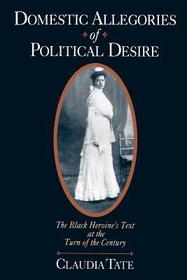
Domestic Allegories of Political Desire
The Black Heroine's Text at the Turn of the Century
- Publisher's listprice GBP 34.99
-
15 797 Ft (15 045 Ft + 5% VAT)
The price is estimated because at the time of ordering we do not know what conversion rates will apply to HUF / product currency when the book arrives. In case HUF is weaker, the price increases slightly, in case HUF is stronger, the price goes lower slightly.
- Discount 10% (cc. 1 579 Ft off)
- Discounted price 14 218 Ft (13 541 Ft + 5% VAT)
Subcribe now and take benefit of a favourable price.
Subscribe
15 797 Ft

Availability
printed on demand
Why don't you give exact delivery time?
Delivery time is estimated on our previous experiences. We give estimations only, because we order from outside Hungary, and the delivery time mainly depends on how quickly the publisher supplies the book. Faster or slower deliveries both happen, but we do our best to supply as quickly as possible.
Product details:
- Publisher OUP USA
- Date of Publication 19 September 1996
- ISBN 9780195108576
- Binding Paperback
- No. of pages312 pages
- Size 229x152x18 mm
- Weight 463 g
- Language English
- Illustrations halftones 0
Categories
Long description:
Why did African-American women novelists use idealized stories of bourgeois courtship and marriage to mount arguments on social reform during the last decade of the nineteenth century, during a time when resurgent racism conditioned the lives of all black Americans? Such stories now seem like apolitical fantasies to contemporary readers. This is the question at the centre of Tate's examination of the novels of Pauline Hopkins, Emma Kelley, Amelia Johnson, Katherine Tillman, and Frances Harper. Domestic Allegories of Political Desire is more than a literary study; it is also a social and intellectual history--a cultural critique of a period that historian Rayford W. Logan called "the Dark Ages of recent American history." Against a rich contextual framework, extending from abolitionist protest to the Black Aesthetic, Tate argues that the idealized marriage plot in these novels does not merely depict the heroine's happiness and economic prosperity. More importantly, that plot encodes a resonant cultural narrative--a domestic allegory--about the political ambitions of an emancipated people. Once this domestic allegory of political desire is unmasked in these novels, it can be seen as a significant discourse of the post-Reconstruction era for representing African-Americans' collective dreams about freedom and for reconstructing those contested dreams into consummations of civil liberty.
"A ground-breaking work....As a pioneering work, it is itself critical history."--Women's Review of Books

