

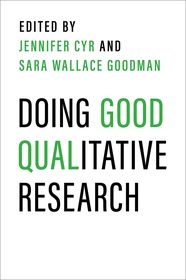
Doing Good Qualitative Research
- Publisher's listprice GBP 64.00
-
30 576 Ft (29 120 Ft + 5% VAT)
The price is estimated because at the time of ordering we do not know what conversion rates will apply to HUF / product currency when the book arrives. In case HUF is weaker, the price increases slightly, in case HUF is stronger, the price goes lower slightly.
- Discount 10% (cc. 3 058 Ft off)
- Discounted price 27 518 Ft (26 208 Ft + 5% VAT)
Subcribe now and take benefit of a favourable price.
Subscribe
30 576 Ft

Availability
printed on demand
Why don't you give exact delivery time?
Delivery time is estimated on our previous experiences. We give estimations only, because we order from outside Hungary, and the delivery time mainly depends on how quickly the publisher supplies the book. Faster or slower deliveries both happen, but we do our best to supply as quickly as possible.
Product details:
- Publisher OUP USA
- Date of Publication 6 June 2024
- ISBN 9780197633137
- Binding Hardback
- No. of pages504 pages
- Size 254x178 mm
- Weight 2270 g
- Language English 518
Categories
Short description:
In Doing Good Qualitative Research, Jennifer Cyr and Sara Wallace Goodman bring together over forty experts to provide one of the first comprehensive introductions to using qualitative methods across the social sciences, from start to finish. Each chapter introduces the theoretical considerations and best practices involved in the application of qualitative data collection and analysis. Additionally, contributors provide first-person accounts of methodology in action, address the expected and unexpected challenges associated with conducting qualitative research, and demonstrate the real-world applications of academic debates.
MoreLong description:
In Doing Good Qualitative Research, Jennifer Cyr and Sara Wallace Goodman bring together over forty experts to provide one of the first comprehensive introductions to using qualitative methods across the social sciences. From concept formation and case selection to fieldwork, analysis, write-up, and publication, this volume provides accessible and practical advice to completing a qualitative research project. In addition to the basics of practicing qualitative research, chapters also discuss rarely covered but important topics, including fieldwork and mental health, interviewing vulnerable populations, fieldwork in violent contexts, and conducting fieldwork as a minoritized scholar. Each chapter introduces the theoretical considerations and best practices involved in the application of qualitative data collection and analysis. Additionally, contributors provide first-person accounts of methodology in action, address the expected and unexpected challenges associated with conducting qualitative research, and demonstrate the real-world applications of academic debates. Doing Good Qualitative Research is an engaging one-stop primer for both scholars and students carrying out qualitative research-based projects, from start to finish.
At last! Social researchers have long needed a single, comprehensive, and up-to-date introduction to the intimidating field of qualitative methods. This volume fulfills that need with stunning success, delivering engaging and accessible contributions of the highest quality. Doing Good Qualitative Research is the place to start for any scholar thinking about using qualitative methods.
Table of Contents:
List of Contributors
List of Tables and Figures
1. Introduction
Jennifer Cyr and Sara Wallace Goodman
Part One: Setting up a Research Project
2. Choosing a Research Question
Julia Lynch
3. The Researcher's Gaze: Positionality and Reflexivity
Lahoma Thomas
4. Theorization and Causality
Cathie Jo Martin
5. The Construction of Knowledge
Jooyoun Lee
6. Case Study and Selection
Sara Wallace Goodman
7. The Potential of Mixed Methods for Qualitative Research
Thalia Gerzso and Rachel Riedl
8. Preparing a Causal Research Design
Jody LaPorte
9. Preparing an Interpretivist Research Design
Tanya Schwarz and Carrie Reiling
Part Two: Preparing for the Field
10. Preparing for the Field: The Nuts and Bolts
Hannah Lebovits
11. Sampling Hard-to-Reach Populations
Rana Khoury
12. Power Dynamics between Researcher and Subject
Rachel Ayrton
13. Developing a Flexible Data-Collection Plan
Lindsay Mayka and Jessica Rich
14. Considering Collaboration as Part of Your Research Design
Mneesha Gellman
15. A Plan for Managing and Storing Your Data
Verónica Pérez Bentancur
Part Three: Collecting Qualitative Data
16. Interviewing Elites
Lantian Li
17. Interviewing and Listening to Ordinary People
Katherine Cramer
18. Interviewing Vulnerable Populations
Wendy Pearlman
19. Focus Groups
Jennifer Cyr
20. Ethnography
Jessica Pisano
21. Supplementing Qualitative Work with Surveys, and Vice Versa
Emily Thorson and Emily Farris
22. Locating and Working with Historical Data
Diana Kim
23. Fieldwork in Fragile Contexts and with High Risk Populations: Ethics, Relationships, and Rapport
Julie Chernov Hwang
24. Studying Indigenous Peoples' Politics: Recommendations for Non-Indigenous Researchers
Tulia Falleti
25. Fieldwork as a Minoritized Scholar
Robin L. Turner
26. Mental Health, Identity, and Fieldwork
Dana El-Kurd and Calla Hummel
27. Navigating Ethical Issues and Choices in the Field
Lauren Duquette-Rury
28. Digital Fieldwork: Opportunities and Challenges
Lauren MacLean, Lahra Smith, and Diana Kapiszewski
Part Four: Analyzing Qualitative Data
29. Reading Closely
Antje Ellermann
30. The Role of Description
Deborah Avant
31. Content Analysis
Zawadi Rucks-Ahidiana
32. Qualitative Social Network Analysis
Jennifer Spindel
33. Process Tracing
Amy Liu
34. Comparative Historical Analysis
Prerna Singh
35. Discourse Analysis
Tania Islas Weinstein
36. Qualitative Comparative Analysis
Ioana-Elena Oana
Part Five: Publishing Qualitative Research
37. Research Transparency in Qualitative Inquiry
Diana Kapiszewski
38. Ethics of Transparency and Data Sharing
Samantha Majic
39. Strategizing Fit and Legibility
Shantel Buggs and Jennifer Sims
40. Publishing Qualitative Research
Sara Wallace Goodman and Jennifer Cyr

