

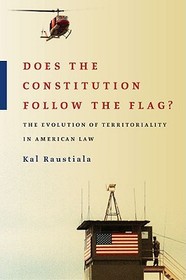
Does the Constitution Follow the Flag?
The Evolution of Territoriality in American Law
- Publisher's listprice GBP 38.99
-
18 627 Ft (17 740 Ft + 5% VAT)
The price is estimated because at the time of ordering we do not know what conversion rates will apply to HUF / product currency when the book arrives. In case HUF is weaker, the price increases slightly, in case HUF is stronger, the price goes lower slightly.
- Discount 10% (cc. 1 863 Ft off)
- Discounted price 16 764 Ft (15 966 Ft + 5% VAT)
Subcribe now and take benefit of a favourable price.
Subscribe
18 627 Ft

Availability
printed on demand
Why don't you give exact delivery time?
Delivery time is estimated on our previous experiences. We give estimations only, because we order from outside Hungary, and the delivery time mainly depends on how quickly the publisher supplies the book. Faster or slower deliveries both happen, but we do our best to supply as quickly as possible.
Product details:
- Publisher OUP USA
- Date of Publication 29 October 2009
- ISBN 9780195304596
- Binding Hardback
- No. of pages328 pages
- Size 157x236x25 mm
- Weight 601 g
- Language English 0
Categories
Long description:
The Bush Administration has notoriously argued that detainees at Guantanamo do not enjoy constitutional rights because they are held outside American borders. But where do rules about territorial legal limits such as this one come from? Why does geography make a difference for what legal rules apply? Most people intuitively understand that location affects constitutional rights, but the legal and political basis for territorial jurisdiction is poorly understood. In this novel and accessible treatment of territoriality in American law and foreign policy, Kal Raustiala begins by tracing the history of the subject from its origins in post-revolutionary America to the Indian wars and overseas imperialism of the 19th century. He then takes the reader through the Cold War and the globalization era before closing with a powerful explanation of America's attempt to increase its extraterritorial power in the post-9/11 world. As American power has grown, our understanding of extraterritorial legal rights has expanded too, and Raustiala illuminates why America's assumptions about sovereignty and territory have changed. Throughout, he focuses on how the legal limits of territorial sovereignty have diminished to accommodate the expanding American empire, and addresses how such limits ought to look in the wake of Iraq, Afghanistan, and the war on terror. A timely and engaging narrative, Does the Constitution Follow the Flag? will change how we think about American territory, American law, and-ultimately-the changing nature of American power.
MoreTable of Contents:
Territoriality in American Law
Territory and the Republic
The Imperial Constitution
The Fall and Rise of Extraterritoriality
America Abroad
The Long Arm of the Law
Offshoring the War on Terror
Territoriality's Evolution

