

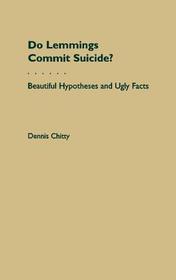
Do Lemmings Commit Suicide?
Beautiful Hypotheses and Ugly Facts
- Publisher's listprice GBP 37.49
-
16 926 Ft (16 120 Ft + 5% VAT)
The price is estimated because at the time of ordering we do not know what conversion rates will apply to HUF / product currency when the book arrives. In case HUF is weaker, the price increases slightly, in case HUF is stronger, the price goes lower slightly.
- Discount 10% (cc. 1 693 Ft off)
- Discounted price 15 233 Ft (14 508 Ft + 5% VAT)
Subcribe now and take benefit of a favourable price.
Subscribe
16 926 Ft

Availability
printed on demand
Why don't you give exact delivery time?
Delivery time is estimated on our previous experiences. We give estimations only, because we order from outside Hungary, and the delivery time mainly depends on how quickly the publisher supplies the book. Faster or slower deliveries both happen, but we do our best to supply as quickly as possible.
Product details:
- Publisher OUP USA
- Date of Publication 11 July 1996
- ISBN 9780195097856
- Binding Hardback
- No. of pages288 pages
- Size 238x162x24 mm
- Weight 644 g
- Language English
- Illustrations frontispiece, halftones, line figures 0
Categories
Short description:
This book is a personal history and apology, written by one of this century's most distinguished small mammal ecologists, for a life in science spent working on problems for which no final dramatic conclusion was reached. Included along the way are some important anecdotes and history about Charles Elton and the pioneering work at the Bureau of Animal Population at Oxford University, from which much of modern population ecology has grown, and insights on the philosophy and practice of science.
MoreLong description:
This book is a personal history and apology, written by one of this century's most distinguished small mammal ecologists, for a life in science spent working on problems for which no final dramatic conclusion was reached. Included along the way are some important anecdotes and history about Charles Elton and the pioneering work at the Bureau of Animal Population at Oxford University, from which most of modern population ecology has grown, and insigts on the philosophy and practice of science.
This is a beautiful hypothesis based on fairly clear assumptions that can be tested experimentally ... well written and full of interesting historical information.
Table of Contents:
Introduction
Pioneering Observations, 1929-1939
Qualitative Changes, 1937-1939
Wartime Rat and Mouse Control, 1939-1946
Replication, 1946-1951
Behavior, Physiology, and Natural Selection, 1949-1961
Controversies, 1952-1956
Varying the Circumstances, 1952-1959
From Wytham Woods to Baker Lane, 1959-1962
Synchrony, 1924-1959
Review, 1923-1961
Epilogue, 1961-1995

