

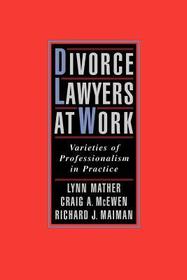
Divorce Lawyers at Work
Varieties of Professionalism in Practice
- Publisher's listprice GBP 37.99
-
18 149 Ft (17 285 Ft + 5% VAT)
The price is estimated because at the time of ordering we do not know what conversion rates will apply to HUF / product currency when the book arrives. In case HUF is weaker, the price increases slightly, in case HUF is stronger, the price goes lower slightly.
- Discount 10% (cc. 1 815 Ft off)
- Discounted price 16 334 Ft (15 557 Ft + 5% VAT)
Subcribe now and take benefit of a favourable price.
Subscribe
18 149 Ft

Availability
printed on demand
Why don't you give exact delivery time?
Delivery time is estimated on our previous experiences. We give estimations only, because we order from outside Hungary, and the delivery time mainly depends on how quickly the publisher supplies the book. Faster or slower deliveries both happen, but we do our best to supply as quickly as possible.
Product details:
- Publisher OUP Oxford
- Date of Publication 27 September 2001
- ISBN 9780195145168
- Binding Paperback
- No. of pages256 pages
- Size 147x226x17 mm
- Weight 374 g
- Language English 0
Categories
Short description:
The authors look at how divorce lawyers actually work to address the question of legal professionalism in practice. Through a detailed and systematic study of legal practice at the micro level, they show how lawyers create their own controls over work through their social relationships, formal and informal norms, common knowledge, and shared values. While much of the research on legal professionalism centers on the formal standards of the bar as reflected in codes of professional responsibility, Mather et al. show how the discretionary judgments that lawyers make, and the choices they face, are actually understood in relation to norms and standards of other lawyers with whom they interact or compare themselves.
MoreLong description:
The authors look at how divorce lawyers actually work to address the question of legal professionalism in practice. Through a detailed and systematic study of legal practice at the micro level, they show how lawyers create their own controls over work through their social relationships, formal and informal norms, common knowledge, and shared values. While much of the research on legal professionalism centers on the formal standards of the bar as reflected in codes of professional responsibility, Mather et al. show how the discretionary judgments that lawyers make, and the choices they face, are actually understood in relation to norms and standards of other lawyers with whom they interact or compare themselves.
More
