

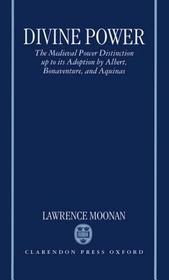
Divine Power
The Medieval Power Distinction up to its Adoption by Albert, Bonaventure, and Aquinas
- Publisher's listprice GBP 157.50
-
71 111 Ft (67 725 Ft + 5% VAT)
The price is estimated because at the time of ordering we do not know what conversion rates will apply to HUF / product currency when the book arrives. In case HUF is weaker, the price increases slightly, in case HUF is stronger, the price goes lower slightly.
- Discount 10% (cc. 7 111 Ft off)
- Discounted price 64 000 Ft (60 953 Ft + 5% VAT)
Subcribe now and take benefit of a favourable price.
Subscribe
71 111 Ft

Availability
printed on demand
Why don't you give exact delivery time?
Delivery time is estimated on our previous experiences. We give estimations only, because we order from outside Hungary, and the delivery time mainly depends on how quickly the publisher supplies the book. Faster or slower deliveries both happen, but we do our best to supply as quickly as possible.
Product details:
- Publisher Clarendon Press
- Date of Publication 28 April 1994
- ISBN 9780198267553
- Binding Hardback
- No. of pages408 pages
- Size 223x143x29 mm
- Weight 650 g
- Language English 0
Categories
Short description:
This is a radically new interpretation of the nature of the power of God, as understood by such thinkers as Aquinas in the Middle Ages. The book provides a clear and illuminating discussion of their arguments, focusing on the distinction they made between so-called 'absolute' and 'ordained' divine power. It is full of important insights into the work of some of the key thinkers of the period, and also challenges modern theologians with the relevance and importance of these ideas today.
MoreLong description:
What can or can't God do? What flexibility is there in the precise manner by which he executes his decrees?
This book is a readically new interpretation of one of the key concepts of medieval religious philosophy: the concept of the power of God. In it Dr Moonan provides a thought-provoking and illuminating analysis of the arguments advanced by the medieval schoolmen to tackle this problem, concentrating in particular on the distinction they made between `absolute' and `ordained' divine power. In doing so, Dr Moonan brings to light some challenging and important new insights on the work of some of the most important thinkers of the Middle Ages - particularly Albert, Bonaventure, and Aquinas.
Dr Moonan also discusses the secular predecessors who influenced these theologians, hitherto, largely overlooked by modern scholars, and as well as tracing the development of their ideas, he advances the case for their relevance and central position in modern religious philosophy today.
This is a stimulating and ground-breaking book, which will not only help to clarify one of the notorious puzzles of medieval religious philosophy, but also provide an important challenge to theologians and philosophers today.
A careful and scholarly work on the history of a small but important issue in thirteenth-century theology ... There is much of value in Moonan's work. The book is thorough, containing a huge wealth of detailed textual discussion. Moonan's treatment of texts, and his exegesis of sometimes very small passages, are exemplary: careful, scholarly, sensitive, and at the same time theologically and philosophically acute. But Moonan also has a clear overall thesis, and displays an admirable grasp of the wider contours of the power distinction: how it fits into thirteenth-century conceptions of the nature of God and of theology. Moonan clarifies a number of points which have long remained obscure ... Moonan has produced a captivating and challenging study of a fascinating and important area in intellectual history.

