

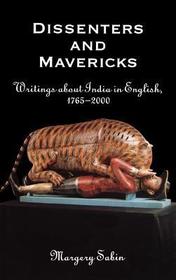
Dissenters and Mavericks
Writings About India in English, 1765-2000
- Publisher's listprice GBP 67.00
-
30 250 Ft (28 810 Ft + 5% VAT)
The price is estimated because at the time of ordering we do not know what conversion rates will apply to HUF / product currency when the book arrives. In case HUF is weaker, the price increases slightly, in case HUF is stronger, the price goes lower slightly.
- Discount 10% (cc. 3 025 Ft off)
- Discounted price 27 225 Ft (25 929 Ft + 5% VAT)
Subcribe now and take benefit of a favourable price.
Subscribe
30 250 Ft

Availability
printed on demand
Why don't you give exact delivery time?
Delivery time is estimated on our previous experiences. We give estimations only, because we order from outside Hungary, and the delivery time mainly depends on how quickly the publisher supplies the book. Faster or slower deliveries both happen, but we do our best to supply as quickly as possible.
Product details:
- Publisher OUP USA
- Date of Publication 21 November 2002
- ISBN 9780195150179
- Binding Hardback
- No. of pages256 pages
- Size 152x234x22 mm
- Weight 496 g
- Language English 0
Categories
Short description:
Dissenters and Mavericks ambitiously reinstates attention to individual authors at the centre of its inquiry into the relationship between literature and history. Offering fresh and provocative interpretations of both well-known and unfamiliar texts, the book joins what is still a tentative movement to open postcolonial studies to the competing values traditionally associated with literary criticism, where the exceptional matters as much as the typical, and analysis seeks to identify the distinctive qualities of thought and language in particular writers. Dissenters and Mavericks reinvigorates the interdisciplinary study of literature, history, and politics through an approach to reading that allows the voices heard in writing a chance to talk back, to exert pressure on the presuppositions and preferences of a wide range of readers.
MoreLong description:
Dissenters and Mavericks ambitiously reinstates individual authors at the centre of its inquiry into the complex relationship between literature and history. Offering fresh and provocative interpretations of both well-known and unfamiliar texts, the book joins what is still a tentative movement to open postcolonial studies to the competing values traditionally associated with literary criticism, where the exceptional matters as much as the typical, and analysis seeks to identify the distinctive qualities of thought and language in particular writers. Without proposing an honour roll of heroic dissenters, Margery Sabin discloses the presence of more skeptical questioning and more variety of thought and expression in the record of writing in English about India than the prevailing categories of postcolonial analysis register.
After an introduction that explores the tension in methods and values between so-called "discourse analysis" and literary criticism, Sabin proceeds to eight chapters about writers who achieve a measure of freedom from the orthodoxies and stereotypes of their diverse, historical moments. Sabin chooses materials from a variety of genres, including letters, political oratory, memoirs, novels, journalism, and travel writing. Many English voices circulate in the first half of the book: Horace Walpole and Edmund Burke in the eighteenth century, Wilkie Collins in the nineteenth, along with lesser-known colonial historians and administrators. Part two features the Indian writers Nirad Chaudhuri, V. S. Naipaul, and Pankaj Mishra, along with lesser-known journalists, novelists, and other Indian intellectuals. Dissenters and Mavericks reinvigorates the interdisciplinary study of literature, history, and politics through an approach to reading that allows the voices heard in writing a chance to talk back, to exert pressure on the presuppositions and preferences of a wide range of readers.
Sabin's engagement with her unusual subject is always meticulous and intelligent; and welcome too, given that it focuses on a nation and a class whose intelligentsia takes itself so seriously.
Table of Contents:
Introduction: Why Dissenters Matter to Literature
Part One: British Writings from the Colonial Period
Anti-Imperialist Wit in Horace Walpole's Letters
Burke's India Campaign: Goliath, Scourge, Redeemer
William Henry Sleeman and the Suttee Romance
Oblivion in The Moonstone
Part Two: Indian Writings After Independence
Prologue to Part Two
The Beast in Nirad Chaudhuri's Garden
The Politics of Cultural Freedom: India in the 1950s
Individuality as a Problem in Naipaul's Indian Narratives
Pankaj Mishra, The Cosmopolitan Possibility
Notes
Bibliography

