

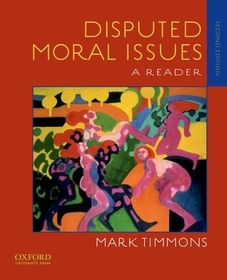
Disputed Moral Issues
A Reader
- Publisher's listprice GBP 60.00
-
27 090 Ft (25 800 Ft + 5% VAT)
The price is estimated because at the time of ordering we do not know what conversion rates will apply to HUF / product currency when the book arrives. In case HUF is weaker, the price increases slightly, in case HUF is stronger, the price goes lower slightly.
- Discount 10% (cc. 2 709 Ft off)
- Discounted price 24 381 Ft (23 220 Ft + 5% VAT)
Subcribe now and take benefit of a favourable price.
Subscribe
27 090 Ft

Availability
Uncertain availability. Please turn to our customer service.
Why don't you give exact delivery time?
Delivery time is estimated on our previous experiences. We give estimations only, because we order from outside Hungary, and the delivery time mainly depends on how quickly the publisher supplies the book. Faster or slower deliveries both happen, but we do our best to supply as quickly as possible.
Product details:
- Edition number Second Edition
- Publisher OUP USA
- Date of Publication 17 May 2012
- ISBN 9780195388725
- Binding Paperback
- No. of pages696 pages
- Size 236x190x25 mm
- Weight 1084 g
- Language English 0
Categories
Short description:
Ideal for courses in contemporary moral problems, introduction to ethics, and applied ethics, Disputed Moral Issues: A Reader, Second Edition, is a comprehensive anthology that brings together seventy-four engaging articles—carefully selected and edited for an undergraduate audience—on a wide range of contemporary moral issues. Striking a unique balance between moral theory and applied ethics, editor Mark Timmons provides students with an accessible Moral Theory
Primer (Chapter 1), in which he outlines the guiding principles of moral theory, presents six central moral theories, and relates those theories to the issues debated in the articles. The second edition features twenty-one new readings, including six selections in a new chapter (2) on moral theories; reading and
discussion questions after each selection; lists of "Additional Resources" at the end of each chapter; an Instructor's Manual; and a Companion Website.
Long description:
Ideal for courses in contemporary moral problems, introduction to ethics, and applied ethics, Disputed Moral Issues: A Reader, Second Edition, is a comprehensive anthology that brings together seventy-four engaging articles on a wide range of contemporary moral issues. Carefully selected and edited for an undergraduate audience, the essays are organized into thirteen chapters that cover moral theory; sexual morality and marriage; pornography, hate speech, and censorship;
drugs, gambling, and addiction; sexism, racism, and reparation; euthanasia and physician-assisted suicide; the ethical treatment of animals; abortion; cloning and genetic enhancement; the death penalty; war, terrorism, and torture; world hunger and poverty; and the environment, consumption, and global warming.
Striking a unique balance between moral theory and applied ethics, editor Mark Timmons provides students with an accessible Moral Theory Primer (Chapter 1), in which he outlines the guiding principles of moral theory, presents six central moral theories, and relates those theories to the issues debated in the articles. Chapter 2—new to this edition—features six readings in moral theory that correspond to the theories presented in the primer. Each of the
remaining chapters is preceded by an introduction, and each selection is preceded by a brief summary and reader cues, which direct students to a specific section of the Moral Theory Primer in order to best help them understand the essay in question. A "Quick Guide to Moral Theories" appendix and an extensive glossary of key terms further
enhance the text. A "User's Guide," which follows the preface, shows instructors how they can integrate moral theories and applied ethics into their courses.
NEW TO THIS EDITION:
* Twenty-one contemporary readings, including six selections in a new chapter on moral theories
* Reading and discussion questions after each selection
* Lists of "Additional Resources" at the end of each chapter featuring annotated guides to both print and online resources
* An Instructor's Manual on CD that provides chapter summaries and goals, quizzes, sample syllabi, references to media and web resources, and sample PowerPoint-based presentations
* A Companion Website at www.oup.com/us/timmons containing the material from the Instructor's Manual as well as student resources (self-quizzes, web links, and suggested readings)
Table of Contents:
*=New to this edition
1. A Moral Theory Primer
1. What Is a Moral Theory?
2. Six Essential Moral Theories
A. Consequentialism
B. Natural Law Theory
C. Kantian Moral Theory
D. Rights-Based Moral Theory
E. Virtue Ethics
F. Ethics of Prima Facie Duty
3. Coping with Many Moral Theories
Appendix: Ethics by Authority?
* 2. Moral Theory Selections
* 1. Jeremy Bentham, The Principle of Utility
* 2. St. Thomas Aquinas, Treatise on Law
* 3. Immanuel Kant, The Moral Law
* 4. John Locke, Natural Rights
* 5. Aristotle, Virtue and Character
* 6. W. D. Ross, What Makes Right Actions Right?
3. Sexual Morality and Marriage
1. Vatican Declaration on Some Questions of Sexual Ethics
2. John Corvino, Why Shouldn't Tommy and Jim Have Sex? A Defense of Homosexuality
3. Thomas A. Mappes, A Liberal View of Sexual Morality and the Concept of Using Another Person
4. Raja Halwani, Virtue Ethics and Adultery
* 5. Maggie Gallagher, Normal Marriage: Two Views
* 6. Evan Wolfson, Enough Marriage to Share
4. Pornography, Hate Speech, and Censorship
1. The Attorney General's Commission on Pornography, Pornography and Harm
2. Nadine Strossen, Why Censoring Pornography Would Not Reduce Discrimination or Violence against Women
3. Ronald Dworkin, Liberty and Pornography
4. Judith M. Hill, Pornography and Degradation
5. Charles R. Lawrence III, Racist Speech as the Functional Equivalent of Fighting Words
6. John Arthur, Sticks and Stones
5. Drugs, Gambling, and Addiction
1. David Boaz, Drug-Free America or Free America?
* 2. Peter de Marneffe, Decriminalize, Don't Legalize
3. Robert E. Goodin, Permissible Paternalism: Saving Smokers from Themselves
4. Daniel Shapiro, Addiction and Drug Policy
5. Peter Collins, Is Gambling Immoral? A Virtue Ethics Approach
* 6. David B. Fletcher, Gambling and Character
6. Sexism, Racism, and Reparation
1. Marilyn Frye, Sexism
2. J. L. A. Garcia, Racism as a Model for Understanding Sexism
3. Michael Philips, Racist Acts and Racist Humor
4. J. Angelo Corlett, Reparations to Native Americans?
5. Louis P. Pojman, Why Affirmative Action Is Immoral
6. Thomas E. Hill, Jr., The Message of Affirmative Action
7. Euthanasia and Physician-Assisted Suicide
* 1. J. Gay-Williams, The Wrongfulness of Euthanasia
2. James Rachels, Active and Passive Euthanasia
3. Bonnie Steinbock, The Intentional Termination of Life
4. Dan W. Brock, Voluntary Active Euthanasia
5. Richard Doerflinger, Assisted Suicide: Pro-Choice or Anti-Life?
6. David T. Watts & Timothy Howell, Assisted Suicide Is Not Voluntary Active Euthanasia
8. The Ethical Treatment of Animals
* 1. Gaverick Matheny, Utilitarianism and Animals
* 2. Tom Regan, Are Zoos Morally Defensible?
* 3. Carl Cohen, Do Animals Have Rights?
4. Mary Ann Warren, Human and Animal Rights Compared
5. Jordan Curnutt, A New Argument for Vegetarianism
9. Abortion
1. Pope John Paul II. The Unspeakable Crime of Abortion
2. Judith Jarvis Thomson, A Defense of Abortion<$>
4. Don Marquis, Why Abortion Is Immoral
* 5. L. W. Sumner, A Moderate View
6. Rosalind Hursthouse, Virtue Theory and Abortion
10. Cloning and Genetic Enhancement
1. John Robertson, Liberty, Identity, and Human Cloning
2. Leon R. Kass, Preventing Brave New World
3. Gregory E. Pence, Will Cloning Harm People?
4. Michael J. Sandel, The Case against Perfection
* 5. Arthur L. Caplan, Good, Better, or Best?
11. The Death Penalty
1. Immanuel Kant, Punishment and the Principle of Equality
2. Stephen Nathanson, An Eye for an Eye?
3. Ernest van den Haag, A Defense of the Death Penalty
* 4. Jeffrey H. Reiman, Civilization, Safety, and Deterrence
5. James S. Liebman, Jeffrey Fagan, Valerie West, and Jonathan Lloyd, Capital Attrition: Error Rates in Capital Cases, 1973-1995
12. War, Terrorism, and Torture
1. Richard A. Wasserstrom, Does Morality Apply to War?
2. Haig Khatchadourian, Terrorism and Morality
3. Michael Walzer, After 9/11: Five Questions about Terrorism
4. James P. Sterba, Terrorism and International Justice
5. Henry Shue, Torture
6. Alan M. Dershowitz, Should the Ticking Bomb Terrorist Be Tortured?
13. World Hunger and Poverty
1.Garrett Hardin, Lifeboat Ethics
* 2. Peter Singer. The Life You Can Save
3. John Arthur, World Hunger and Moral Obligation
4. Amartya Sen, Property and Hunger
5. Onora O'Neill, A Kantian Approach to World Hunger
14. The Environment, Consumption, and Global Warming
1. William F. Baxter, People or Penguins? The Case for Optimal Pollution
2. Aldo Leopold, The Land Ethic
3. Thomas E. Hill, Jr., Ideals of Human Excellence and Preserving the Natural Environment
* 4. Peter Wenz, Synergistic Environmental Virtues: Consumerism and Human Flourishing
* 5. Walter Sinnott-Armstrong, It's Not My Fault: Global Warming and Individual Moral Obligations
*6. Bjorn Lomborg, Let's Keep Our Cool about Global Warming

