

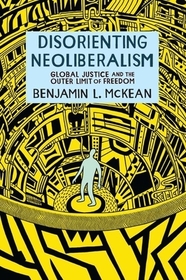
Disorienting Neoliberalism
Global Justice and the Outer Limit of Freedom
- Publisher's listprice GBP 81.00
-
36 571 Ft (34 830 Ft + 5% VAT)
The price is estimated because at the time of ordering we do not know what conversion rates will apply to HUF / product currency when the book arrives. In case HUF is weaker, the price increases slightly, in case HUF is stronger, the price goes lower slightly.
- Discount 10% (cc. 3 657 Ft off)
- Discounted price 32 914 Ft (31 347 Ft + 5% VAT)
Subcribe now and take benefit of a favourable price.
Subscribe
36 571 Ft

Availability
printed on demand
Why don't you give exact delivery time?
Delivery time is estimated on our previous experiences. We give estimations only, because we order from outside Hungary, and the delivery time mainly depends on how quickly the publisher supplies the book. Faster or slower deliveries both happen, but we do our best to supply as quickly as possible.
Product details:
- Publisher OUP USA
- Date of Publication 13 November 2020
- ISBN 9780190087807
- Binding Hardback
- No. of pages310 pages
- Size 157x236x25 mm
- Weight 590 g
- Language English 54
Categories
Short description:
Many people believe the global economy is unjust, but they don't know what to do about it. What responsibilities do American consumers have to workers in China making their iPhones? Should they still buy clothes made in Bangladesh's sweatshops? Offering an overview of how neoliberalism orients us to the world, Benjamin L. McKean shows the practical shortcomings of neoliberal approaches to the world and develops an alternative way of thinking and acting guided by a compelling new account of freedom. Disorienting Neoliberalism offers a framework for understanding the politics of the global economy and shows how we can act in solidarity to promote justice.
MoreLong description:
In the world neoliberalism has made, the pervasiveness of injustice and the scale of inequality can be so overwhelming that meaningful resistance seems impossible. Disorienting Neoliberalism argues that combatting the injustices of today's global economy begins with reorienting our way of seeing so that we can act more effectively. Within political theory, standard approaches to global justice envision ideal institutions, but provide little guidance for people responding to today's most urgent problems. Meanwhile, empirical and historical research explains how neoliberalism achieved political and intellectual hegemony, but not how we can imagine its replacement.
Disorienting Neoliberalism argues that people can and should become disposed to solidarity with each other once they see global injustices as a limit on their own freedom. Benjamin L. McKean reorients us by taking us inside the global supply chains that assemble clothes, electronics, and other goods, revealing the tension between neoliberal theories of freedom and the hierarchical, coercive reality of their operations. In this new approach to global justice, he explains how neoliberal institutions and ideas constrain the freedom of people throughout the supply chain from worker to consumer. Rather than a linked set of private market exchanges, supply chains are political entities that seek to govern the rest of us. Where neoliberal institutions train us to see each other as competitors, McKean provides a new orientation to the global economy in which we can see each other as partners in resisting a shared obstacle to freedom — and thus be called to collective action.
Drawing from a wide range of thinkers, from Hegel and John Rawls to W. E. B. Du Bois and Iris Marion Young, Disorienting Neoliberalism shows how political action today can be meaningful and promote justice, moving beyond the pity and resentment global inequality often provokes to a new politics of solidarity.
McKean's theory of freedom within the supply chain builds on an admirably diverse set of authors. He reads generously and synthetically across traditions to propose a comprehensive vision of how we might understand and work for genuine freedom within a global economy
Table of Contents:
Introduction: Injustice in a Disorienting World
Chapter 1: Neoliberal Theory as a Source of Orientation
Chapter 2: Seeling (Like) Supply Chain Managers
Chapter 3: The Outer Limit of Freedom
Chapter 4: Ugly Progress and Unhopeful Hope
Chapter 5: The Significance of Solidarity
Chapter 6: Why Sovereignty Is Not the Solution
Conclusion: Freedom and Resentment Amid Neoliberalism
Acknowledgments
Notes
Index

