

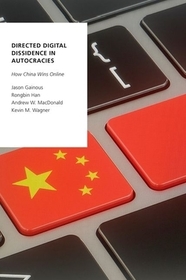
Directed Digital Dissidence in Autocracies
How China Wins Online
Series: Oxford Studies in Digital Politics;
- Publisher's listprice GBP 20.99
-
9 476 Ft (9 025 Ft + 5% VAT)
The price is estimated because at the time of ordering we do not know what conversion rates will apply to HUF / product currency when the book arrives. In case HUF is weaker, the price increases slightly, in case HUF is stronger, the price goes lower slightly.
- Discount 10% (cc. 947 Ft off)
- Discounted price 8 529 Ft (8 123 Ft + 5% VAT)
Subcribe now and take benefit of a favourable price.
Subscribe
9 476 Ft

Availability
Estimated delivery time: In stock at the publisher, but not at Prospero's office. Delivery time approx. 3-5 weeks.
Not in stock at Prospero.
Why don't you give exact delivery time?
Delivery time is estimated on our previous experiences. We give estimations only, because we order from outside Hungary, and the delivery time mainly depends on how quickly the publisher supplies the book. Faster or slower deliveries both happen, but we do our best to supply as quickly as possible.
Product details:
- Publisher OUP USA
- Date of Publication 4 January 2024
- ISBN 9780197680391
- Binding Paperback
- No. of pages184 pages
- Size 235x156x10 mm
- Weight 354 g
- Language English 521
Categories
Short description:
Drawing on original survey data and rich qualitative sources, Directed Digital Dissidence in Autocracies explores how authoritarian regimes employ the Internet in advantageous ways to direct the flow of online information. The authors argue that the central Chinese government successfully directs citizen dissent toward local government through critical information that the central government places online--a strategy that the authors call "directed digital dissidence". In this context, citizens engage in low-level protest toward the local government, and thereby feel empowered, while the central government avoids overthrow. With an in-depth look at the COVID-19 and Xinjiang Cotton cases, the authors demonstrate how the Chinese state employs directed digital dissidence and discuss the impact and limitations of China's information strategy.
MoreLong description:
Does the Internet fundamentally change the flow of politically relevant information, even in authoritarian regimes? If so, does it alter the attitudes and behavior of citizens? While there is a fair amount of research exploring how social media has empowered social actors to challenge authoritarian regimes, there is much less addressing whether and how the state can actively shape the flow of information to its advantage. In China, for instance, citizens often resort to "rightful resistance" to lodge complaints and defend rights. By using the rhetoric of the central government, powerless citizens may exploit the slim political opportunity structure and negotiate with the state for better governance. But this tactic also reinforces the legitimacy of authoritarian states; citizens engage rightful resistance precisely because they trust the state, at least the central government, to some degree.
Drawing on original survey data and rich qualitative sources, Directed Digital Dissidence in Autocracies explores how authoritarian regimes employ the Internet in advantageous ways to direct the flow of online information. The authors argue that the central Chinese government successfully directs citizen dissent toward local government through critical information that the central government places online--a strategy that the authors call "directed digital dissidence". In this context, citizens engage in low-level protest toward the local government, and thereby feel empowered, while the central government avoids overthrow. Consequently, the Internet functions to discipline local state agents and to project a benevolent image of the central government and the regime as a whole. With an in-depth look at the COVID-19 and Xinjiang Cotton cases, the authors demonstrate how the Chinese state employs directed digital dissidence and discuss the impact and limitations of China's information strategy.
The monograph provides an intriguing exploration of the effects of information control and public opinion management in China. It will appeal to a wide readership including China specialists, scholars of comparative authoritarianism, students of political communication and anyone interested in the impact of digital technologies on society and governance.
Table of Contents:
Chapter 1 - The China Case: Strong State, Popular Contention, and the Internet
Chapter 2 -The Chinese Internet: Citizen Awareness of Government Control
Chapter 3 - What Does Directed Digital Dissidence Look Like? Critical Information Flows, Trust, and Support for Protest
Chapter 4 - Social Media: The Battleground of the Information War
Chapter 5 - Jumping Over the Great Firewall: A Threat to the Chinese Strategy
Chapter 6 - The Digital Dissident Citizen: Who are the Wall Jumpers?
Chapter 7 - Managing the Information War: Voices Heard from Beyond the Wall are Lost
Chapter 8 - Digital Directed Dissidence in Action: Applications and its Limits
Chapter 9 - Will Digital Directed Dissidence Keep Working?
Appendices
Notes
References
Index

