

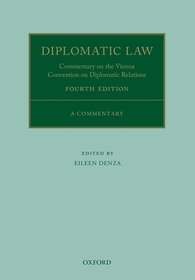
Diplomatic Law 4E
Commentary on the Vienna Convention on Diplomatic Relations
Series: Oxford Commentaries on International Law;
- Publisher's listprice GBP 272.50
-
123 033 Ft (117 175 Ft + 5% VAT)
The price is estimated because at the time of ordering we do not know what conversion rates will apply to HUF / product currency when the book arrives. In case HUF is weaker, the price increases slightly, in case HUF is stronger, the price goes lower slightly.
- Discount 10% (cc. 12 303 Ft off)
- Discounted price 110 730 Ft (105 458 Ft + 5% VAT)
Subcribe now and take benefit of a favourable price.
Subscribe
123 033 Ft

Availability
Out of print
Why don't you give exact delivery time?
Delivery time is estimated on our previous experiences. We give estimations only, because we order from outside Hungary, and the delivery time mainly depends on how quickly the publisher supplies the book. Faster or slower deliveries both happen, but we do our best to supply as quickly as possible.
Product details:
- Edition number 4
- Publisher OUP Oxford
- Date of Publication 14 January 2016
- ISBN 9780198703969
- Binding Hardback
- No. of pages472 pages
- Size 249x179x32 mm
- Weight 908 g
- Language English 0
Categories
Short description:
This fully updated fourth edition of Denza's renowned commentary examines the universally-accepted framework for diplomacy between sovereign States. Denza places each provision of the Convention in its historical context and provides commentary on the application of the Convention by the UK, the US, and other States.
MoreLong description:
The 1961 Vienna Convention on Diplomatic Relations has for over 50 years been central to diplomacy and applied to all forms of relations among sovereign States. Participation is almost universal. The rules giving special protection to ambassadors are the oldest established in international law and the Convention is respected almost everywhere. But understanding it as a living instrument requires knowledge of its background in customary international law, of the negotiating history which clarifies many of its terms and the subsequent practice of states and decisions of national courts which have resolved other ambiguities. Diplomatic Law provides this in-depth Commentary. The book is an essential guide to changing methods of modern diplomacy and shows how challenges to its regime of special protection for embassies and diplomats have been met and resolved. It is used by ministries of foreign affairs and cited by domestic courts world-wide.
The book analyzes the reasons for the widespread observance of the Convention rules and why in the special case of communications - where there is flagrant violation of their special status - these reasons do not apply. It describes how abuse has been controlled and how the immunities in the Convention have survived onslaught by those claiming that they should give way to conflicting entitlements to access to justice and the desire to punish violators of human rights. It describes how the duty of diplomats not to interfere in the internal affairs of the host State is being narrowed in the face of the communal international responsibility to monitor and uphold human rights.
This book is an erudite and impressive statement of what diplomatic law actually is and what, presumably, it may become, bearing in mind such ongoing controversies as the tension between the principle of non-interference in the affairs of a particular country - and the duty to promote and champion the basic tenets of human rights.
Table of Contents:
Introduction
Commentary on Preamble
Commentary on Articles 1- 53
Commentary on optional protocols
Appendix 1: The Vienna Convention on Diplomatic Relations
Appendix 2: Parties to the Vienna Convention on Diplomatic Relations

