

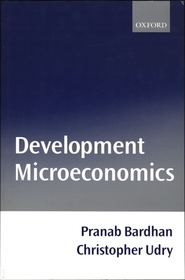
Development Microeconomics
- Publisher's listprice GBP 63.00
-
28 444 Ft (27 090 Ft + 5% VAT)
The price is estimated because at the time of ordering we do not know what conversion rates will apply to HUF / product currency when the book arrives. In case HUF is weaker, the price increases slightly, in case HUF is stronger, the price goes lower slightly.
- Discount 10% (cc. 2 844 Ft off)
- Discounted price 25 600 Ft (24 381 Ft + 5% VAT)
Subcribe now and take benefit of a favourable price.
Subscribe
28 444 Ft

Availability
printed on demand
Why don't you give exact delivery time?
Delivery time is estimated on our previous experiences. We give estimations only, because we order from outside Hungary, and the delivery time mainly depends on how quickly the publisher supplies the book. Faster or slower deliveries both happen, but we do our best to supply as quickly as possible.
Product details:
- Publisher OUP Oxford
- Date of Publication 6 May 1999
- ISBN 9780198773719
- Binding Paperback
- No. of pages252 pages
- Size 234x157x14 mm
- Weight 402 g
- Language English
- Illustrations illustrations 0
Categories
Short description:
Traditional development economics has recently been revolutionized by the application of new economic tools and concepts. Development Microeconomics is the first in a series of books which will look at the entire spectrum of development economics issues, combining the strengths of conventional developmental thought with the insights of contemporary mainstream economics. High technical sophistication is avoided, and the only pre-requisite is some familiarity with the tools of general microecomic theory at a first-year graduate or advanced undergraduate level.
MoreLong description:
Traditional development economics has recently been revolutionized by the application of new economic tools and concepts. Development Microeconomics is the first in a series of books which will look at the entire spectrum of development economics issues, combining the strengths of conventional developmental thought with the insights of contemporary mainstream economics.
The main new conceptual tool used is the application of the theory of imperfect information and the effects this has on the the behaviour of economic agents. This helps to explain why perfect competition models rarely have success when dealing with developing economies. The authors also stress the necessity of balance in dealing with many of the classic problems in development studiesthe importance of both the individual as economic agent and cultural norms as the framework of social behaviour; the dual relationship between equity and efficiency in economic policy-making; the importance of market rivalry and the potential of market breakdown.
Designed specifically for graduate students, this book analyses the key microeconomic problems facing the very poorest sectors of developing economies. It utilises simple theoretical models, and is presented in a compact and analytical form. High technical sophistication is avoided, and the only pre-requisite is some familiarity with the tools of general microecomic theory at a first-year graduate or advanced undergraduate level.
This is an excellent book. It is a comprehensive survey of the issues of the household economy in developing countries ... essential reading not only for graduate students, but also for anyone intending to do research in development economics ... It sure made me want to read more.
Table of Contents:
Introduction
Household Economics
Population
Fragmented Markets: Labour
Migration
Rural Land Market
Fragmented Credit Markets
Risk and Insurance in an Agricultural Economy
Interlinkage of Transactions and Rural Development
Human Capital and Income Distribution
Poverty Alleviation: Efficiency and Equity Issues
Technological Progress and Learning
Environment and Development
Trade and Development
The Dual Economy
Intersectoral Complementarities and Coordination Failures
Instiutional Economics and the State in Economic Development

