

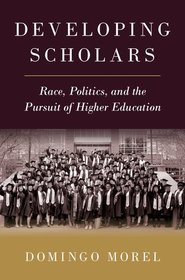
Developing Scholars
Race, Politics, and the Pursuit of Higher Education
- Publisher's listprice GBP 21.99
-
9 928 Ft (9 455 Ft + 5% VAT)
The price is estimated because at the time of ordering we do not know what conversion rates will apply to HUF / product currency when the book arrives. In case HUF is weaker, the price increases slightly, in case HUF is stronger, the price goes lower slightly.
- Discount 10% (cc. 993 Ft off)
- Discounted price 8 935 Ft (8 510 Ft + 5% VAT)
Subcribe now and take benefit of a favourable price.
Subscribe
9 928 Ft

Availability
Estimated delivery time: In stock at the publisher, but not at Prospero's office. Delivery time approx. 3-5 weeks.
Not in stock at Prospero.
Why don't you give exact delivery time?
Delivery time is estimated on our previous experiences. We give estimations only, because we order from outside Hungary, and the delivery time mainly depends on how quickly the publisher supplies the book. Faster or slower deliveries both happen, but we do our best to supply as quickly as possible.
Product details:
- Publisher OUP USA
- Date of Publication 8 June 2023
- ISBN 9780197637005
- Binding Paperback
- No. of pages248 pages
- Size 226x160x25 mm
- Weight 363 g
- Language English 294
Categories
Short description:
In Developing Scholars, Domingo Morel explores the history and political factors that led to the creation of community-centered affirmative action programs for students of color in the 1960s. Through a case study of an existing program, Talent Development, Morel shows how protest, including violent protest, has been instrumental in the maintenance of college access programs. He also reveals that in response to the college expansion efforts of the 1960s, hidden forms of restriction emerged that have significantly impacted students of color. Developing Scholars argues that the origin, history, and purpose of these programs reveal gaps in our understanding of college access expansion in the US that challenge conventional wisdom of American politics.
MoreLong description:
Over the past fifty years, debates concerning race and college admissions have focused primarily on the policy of affirmative action at elite institutions of higher education. But a less well-known approach to affirmative action also emerged in the 1960s in response to urban unrest and Black and Latino political mobilization. The programs that emerged in response to community demands offered a more radical view of college access: admitting and supporting students who do not meet regular admissions requirements and come from families who are unable to afford college tuition, fees, and other expenses. While conventional views of affirmative action policies focus on the "identification" of high-achieving students of color to attend elite institutions of higher education, these programs represent a community-centered approach to affirmative action. This approach is based on a logic of developing scholars who can be supported at their local public institutions of higher education.
In Developing Scholars, Domingo Morel explores the history and political factors that led to the creation of college access programs for students of color in the 1960s. Through a case study of an existing community-centered affirmative action program, Talent Development, Morel shows how protest, including violent protest, has been instrumental in the maintenance of college access programs. He also reveals that in response to the college expansion efforts of the 1960s, hidden forms of restriction emerged that have significantly impacted students of color. Developing Scholars argues that the origin, history, and purpose of these programs reveal gaps in our understanding of college access expansion in the US that challenge conventional wisdom of American politics.
Developing Scholars makes an important intervention in scholarship on college access policies by centering the social movements which produced college access for Black and Brown students, while also shining a light on the many ways these programs have been restrained and stripped of their power through the implementation of secondary admissions criteria and defunding. Importantly, this book illustrates that for many Black and Brown students, higher education is not an individual pursuit, but rather a collective undertaking made possible by social movements and continually sustained by community members. This book should be read by scholars of higher education and social movements.
Table of Contents:
List of Tables
Introduction: Graduation Day
Part I Social Movements for College Access
Chapter 1: Rebellion and College for All: Community-Centered Affirmative Action and the Role of Violent Protest in Policy Formation and Policy Maintenance
Chapter 2: Creating TD Nation: Community Action, Protest, and a Program for "Disadvantaged" Youth
Chapter 3: Resisting Retrenchment
Chapter 4: The Work of Developing Scholars
Part II Reproducing Restriction to College Access
Chapter 5: Emergence of Hidden Forms of Restriction: The Myth of "Major of Choice"
Chapter 6: Shifting the Politics of College Access from the Public to Private Sphere
Chapter 7: A Developing Scholars Approach
Epilogue: Protest as Policy Feedback
Acknowledgments
Appendix A (Special College Access Programs 1966-1972)
Appendix B (Data Sources for GPA Statistical Analysis)
References
Index

