

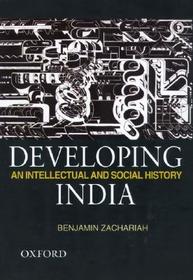
Developing India
An Intellectual and Social History c.1930-50
- Publisher's listprice GBP 21.99
-
9 928 Ft (9 455 Ft + 5% VAT)
The price is estimated because at the time of ordering we do not know what conversion rates will apply to HUF / product currency when the book arrives. In case HUF is weaker, the price increases slightly, in case HUF is stronger, the price goes lower slightly.
- Discount 10% (cc. 993 Ft off)
- Discounted price 8 935 Ft (8 510 Ft + 5% VAT)
Subcribe now and take benefit of a favourable price.
Subscribe
9 928 Ft

Availability
Uncertain availability. Please turn to our customer service.
Why don't you give exact delivery time?
Delivery time is estimated on our previous experiences. We give estimations only, because we order from outside Hungary, and the delivery time mainly depends on how quickly the publisher supplies the book. Faster or slower deliveries both happen, but we do our best to supply as quickly as possible.
Product details:
- Publisher OUP India
- Date of Publication 18 August 2005
- ISBN 9780195670585
- Binding Hardback
- No. of pages304 pages
- Size 226x148x25 mm
- Weight 631 g
- Language English 0
Categories
Short description:
This book is an intellectual history of development and other related ideas in India during the important planning years of 1930 - 50. It deals with the underlying notions of progress, self government, and nation-building contained in developmental goals articulated in India in the late colonial period, the middle of the twentieth century. This work attempts to fill an important lacuna as historical work on the subject of development is relatively rare.
MoreLong description:
This book considers how the idea of development in India took shape in the 1930s and the 1940s, drawing on a variety of intellectual resources, driven by immediate political battles, yet inspired by a vision of the future that incorporated notions of freedom and fairness. The argument is that an Indian notion of development, consciously different from the western one based on free trade and industrialization, could emerge in the inter-war period, when the future of
capitalism in the west did not appear as assured as it did in the nineteenth century. The author identifies three interlocking themes around which development was conceptualized during this period the importance of science, technology, the need for the government to express certain social
concerns, and the need of for national discipline.
The book opens up a new field of historiography of South Asia, that of an intellectual history of late colonialism in India, and of the nationalism that succeeded it.
Table of Contents:
Preface
Introduction: The Problem, The Approach
Chapter I: 1. Political Economy, Precedents and ideas, metropolitan and colobnial, 2. Shared Spaces of Domination and Resistance, 3. Terminology, 4. The circulation of Ideas and Information, 4. Conclusion
Chapter II: A Reformed Imperium? 1. Levels of Governance and the Narrow Range, 2. The 1930s: Aberrations and Default Settings, 3. Post-war Reconstruction and Development, 4. The Fringes of Government, 5. Conclusions
Chapter III. Towards a political Philosophy of the Village Community: The debate on Gandhian ideas, Placing Gandhi, The political context, Against Gandhi, Gandhi s earlier interventions, 2. Gandhi s Economic Avatar and the coming of J C Kumarappa The Uses of Economic Agreement, Addressing the Intelligentsia
3. Kumarappa s Village Movement: Evolution, Economics, and Civilization, Science, Economics and the Eastern Modern, Practical Arguments, 4. Conclusions: Statement, Communicability, (Mis?)readings
Chapter IV. Devel
opment: Possible Nations, 1. Middle Class Intellectuals, 2. Form and Content: Compromise Formulae, Divergent Goals, 3. Lineages. Socialism , Science, Morality, Modernity, National Discipline, 4. The Uses of a Language Legitimacy
Chapter V. Conclusion
Select Bibliography
Reference

