

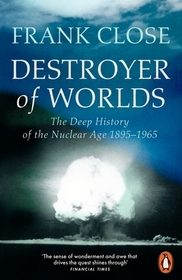
Destroyer of Worlds
The Deep History of the Nuclear Age: 1895-1965
-
GET 20% OFF
- Publisher's listprice GBP 14.99
-
6 767 Ft (6 445 Ft + 5% VAT)
The price is estimated because at the time of ordering we do not know what conversion rates will apply to HUF / product currency when the book arrives. In case HUF is weaker, the price increases slightly, in case HUF is stronger, the price goes lower slightly.
- Discount 20% (cc. 1 353 Ft off)
- Discounted price 5 414 Ft (5 156 Ft + 5% VAT)
- Discount is valid until: 31 August 2026
5 414 Ft

Availability
Not yet published.
Why don't you give exact delivery time?
Delivery time is estimated on our previous experiences. We give estimations only, because we order from outside Hungary, and the delivery time mainly depends on how quickly the publisher supplies the book. Faster or slower deliveries both happen, but we do our best to supply as quickly as possible.
Product details:
- Publisher Penguin Books Ltd
- Date of Publication 6 August 2026
- ISBN 9781802066029
- Binding Paperback
- No. of pages336 pages
- Size 196x130x21 mm
- Weight 278 g
- Language English 700
Categories
Long description:
**A Guardian Best Science and Nature Book of 2025**
From the award-winning science writer, a new history of the development of nuclear power and the extraordinary minds behind it
Henry Becquerel’s accidental discovery, in Paris in 1896, of a faint smudge on a photographic plate sparked a chain of discoveries which would unleash the atomic age.
Destroyer of Worlds is the story of how pursuit of this hidden source of nuclear power, which began innocently and collaboratively, was overwhelmed by the politics of the 1930s, and following devastation of Hiroshima and Nagasaki opened the way to a still more terrible possibility: a thermonuclear bomb, the so-called “backyard weapon”, that could destroy all life on earth – from anywhere.
The story spans decades and continents, moving from Becquerel to Ernest Rutherford, the Cambridge-based, New Zealand scientist who first split the atom, expands to include Enrico Fermi in Rome, Otto Hahn and Lise Meitner in Berlin and the Joliot-Curies in Paris, leading to the appearance of Robert Oppenheimer before climaxing with increasingly horrifying developments in the USA and USSR. The roles of three remarkable women – Lise Meitner, Ida Noddack and Irene Curie – are re-evaluated, and there are new insights into the work of Ettore Majorana, Fermi’s mercurial but brilliant assistant, who mysteriously disappeared in 1938, possibly after foreseeing the explosive power of nuclear energy. Above all, this is a story of how knowledge is often advanced by personal convictions and relationships, an indeed by chance, in a remarkable way.

