

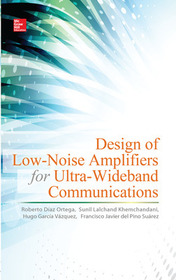
Design of Low-Noise Amplifiers for Ultra-Wideband Communications
Series: ELECTRONICS;
- Publisher's listprice GBP 103.99
-
46 951 Ft (44 715 Ft + 5% VAT)
The price is estimated because at the time of ordering we do not know what conversion rates will apply to HUF / product currency when the book arrives. In case HUF is weaker, the price increases slightly, in case HUF is stronger, the price goes lower slightly.
- Discount 10% (cc. 4 695 Ft off)
- Discounted price 42 256 Ft (40 244 Ft + 5% VAT)
Subcribe now and take benefit of a favourable price.
Subscribe
46 951 Ft

Availability
Estimated delivery time: In stock at the publisher, but not at Prospero's office. Delivery time approx. 3-5 weeks.
Not in stock at Prospero.
Why don't you give exact delivery time?
Delivery time is estimated on our previous experiences. We give estimations only, because we order from outside Hungary, and the delivery time mainly depends on how quickly the publisher supplies the book. Faster or slower deliveries both happen, but we do our best to supply as quickly as possible.
Product details:
- Publisher McGraw Hill
- Date of Publication 16 February 2014
- ISBN 9780071823128
- Binding Hardback
- No. of pages128 pages
- Size 269x116x15 mm
- Weight 348 g
- Language English 0
Categories
Long description:
Publisher's Note: Products purchased from Third Party sellers are not guaranteed by the publisher for quality, authenticity, or access to any online entitlements included with the product.
Cutting-edge techniques for ultra-wideband, low-noise amplifier design
This pioneering resource presents alternatives for implementing power- and area-efficient integrated low-noise amplifiers for ultra-wideband communications. Design methodologies for distributed amplifiers, feedback amplifiers, inductor structures with reduced area, and inductorless techniques are discussed. Cowritten by international experts in industry and academia, this book addresses the state of the art in integrated circuitdesign in the context of emerging systems.
Design of Low-Noise Amplifiers for Ultra-WidebandCommunications covers:
- Ultra-wideband overview and system approach
- Distributed amplifiers
- Wideband low-noise amplifiers
- Feedback wideband low-noise amplifiers
- Inductorless techniques
Publisher's Note: Products purchased from Third Party sellers are not guaranteed by the publisher for quality, authenticity, or access to any online entitlements included with the product.
Cutting-edge techniques for ultra-wideband, low-noise amplifier design
This pioneering resource presents alternatives for implementing power- and area-efficient integrated low-noise amplifiers for ultra-wideband communications. Design methodologies for distributed amplifiers, feedback amplifiers, inductor structures with reduced area, and inductorless techniques are discussed. Cowritten by international experts in industry and academia, this book addresses the state of the art in integrated circuitdesign in the context of emerging systems.
Design of Low-Noise Amplifiers for Ultra-WidebandCommunications covers:
- Ultra-wideband overview and system approach
- Distributed amplifiers
- Wideband low-noise amplifiers
- Feedback wideband low-noise amplifiers
- Inductorless techniques
Table of Contents:
Nomenclature
1 Ultra-Wideband Overview and System Approach
1.1 Introduction
1.2 History of Ultra-Wideband Communications
1.3 ECMA-368/ISO/IEC 26907 Receiver Specifications
1.3.1 Operating Frequency Band
1.3.2 Receiver Sensitivity
1.4 Receiver System Design
1.4.1 Noise Figure
1.4.2 Channel Filter and ADC Specifications
1.4.3 ADC and Frontend Gain Specifications
1.4.4 Automatic Gain Control
1.4.5 Linearity Requirements
1.4.6 Synthesizer Requirements
1.4.7 Budget Simulations
1.5 Conclusions
2 Distributed Amplifiers
2.1 Introduction
2.2 Theoretical Approach
2.3 Area Optimization
2.3.1 Compact Design
2.3.2 Stacked Inductors
2.4 Experimental Results
2.5 Conclusions
3 Wideband Low-Noise Amplifiers
3.1 Introduction
3.2 Wideband Low-Noise Amplifier
3.2.1 Narrowband Inductively Degenerated Amplifier
3.2.2 Wideband Inductively Degenerated Amplifier
3.2.3 Wideband Low-Noise Amplifier Design
3.2.4 Experimental Results
3.3 Flatness Improvement
3.3.1 Circuit Description
3.3.2 Experimental Results
3.4 Wideband Folded Cascode Amplifier
3.4.1 Narrowband Folded Cascode Amplifier
3.4.2 Wideband Folded Cascode Amplifier Topology
3.4.3 Experimental Results
3.5 Conclusions
4 Feedback Wideband Low-Noise Amplifiers
4.1 Introduction
4.2 Circuit Analysis
4.3 Modified Miniatured 3D Inductor
4.4 Circuit Design
4.5 Experimental Results
4.6 Conclusions
5 Inductorless Techniques
5.1 Introduction
5.2 Common Gate LNA
5.2.1 Input Matching and Voltage Gain
5.2.2 Noise of a CG Stage
5.2.3 Differential Operation of CG Stage
5.3 Mixer Design
5.3.1 Quadrature Mixers
5.3.2 Mixers with Current Boosting
5.4 Inductorless Operation
5.5 Experimental Results
5.5.1 Frontend I
5.5.2 Frontend II
5.5.3 Comparison Between Frontends
5.6 Conclusions
Bibliography
Index

