

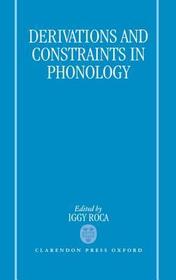
Derivations and Constraints in Phonology
- Publisher's listprice GBP 195.00
-
93 161 Ft (88 725 Ft + 5% VAT)
The price is estimated because at the time of ordering we do not know what conversion rates will apply to HUF / product currency when the book arrives. In case HUF is weaker, the price increases slightly, in case HUF is stronger, the price goes lower slightly.
- Discount 10% (cc. 9 316 Ft off)
- Discounted price 83 845 Ft (79 853 Ft + 5% VAT)
Subcribe now and take benefit of a favourable price.
Subscribe
93 161 Ft

Availability
printed on demand
Why don't you give exact delivery time?
Delivery time is estimated on our previous experiences. We give estimations only, because we order from outside Hungary, and the delivery time mainly depends on how quickly the publisher supplies the book. Faster or slower deliveries both happen, but we do our best to supply as quickly as possible.
Product details:
- Publisher Clarendon Press
- Date of Publication 17 July 1997
- ISBN 9780198236894
- Binding Hardback
- No. of pages616 pages
- Size 243x163x39 mm
- Weight 1074 g
- Language English
- Illustrations line illustrations 0
Categories
Short description:
Since the 1960s phonological theory has countenanced two levels of representation, underlying and surface form, linked by a multi-staged derivation. This model is now being challenged by approaches, such as Optimality Theory, which substitute surface constraints for rules and derivations. If accepted, this shift would amount to a major revolution in the field. In this volume, a team of leading specialists addresses the issue, specifically focusing on the comparison and evaluation of the two alternatives.
MoreLong description:
For the first time in over thirty years a revolution is happening in phonology, with the advent of constraint-based approaches which directly oppose the rule-and-derivation tradition of mainstream Generative Phonology. The success of Optimality Theory and the rapidity of its spread since its official launch in 1993 is remarkable even by the general standards of post-1950s linguistics. Many phonologists appear to have been caught up in the whirlwind, as witnessed by the substance of many current working papers and conferences the world over, and the recent contents of well-established journals. Two questions naturally arise: What is Optimality Theory about? In what way is Optimality Theory superior to traditional theory, if indeed it is?
In this book, leading specialists and active researchers address these issues directly, and focus deliberately on the evaluation of the two competing approaches rather than on simple displays of their applicability to limited bodies of data.
There is a lot of interesting discussion and good linguistics in this book ... any reader who finds the arguments for OT to be convincing should read more carefully.
Table of Contents:
Preface
PART I Preliminaries
Derivations or Constraints, or Derivations and Constraints?
Questions of Priorities: An Introduction to Optimality Theory in Phonology
PART II Theoretical Investigations
The Contents of Phonological Status
Expressing Phonetic Naturalness in Phonology
Gradient Retreat
PART III Empirical Studies
The Yokuts Challenge
Rules in Optimality Theory: Two Case Studies
Non-derivational Phonology Meets Lexical Phonology
Berber Syllabification: Derivations or Constraints?
/r/ Hypercorrection and the Elsewhere Condition
Underlying Representations in Optimality Theory
Phonological Derivations and Historical Changes in Hebrew Spirantization
Exceptions and Static Phonological Patterns
Correspondence and Compositionality: The Ga-gyo Variation in Japanese Phonology
Rhythmic Vowel Deletion in Optimality Theory
Attic Greek Accentuation and Intermediate Derivational Representation
Non-transparent Constraints and Intermediate Derivational Representations
Extrasyllabic Consonants in Polish: Derivational Optimality Theory
Index

