

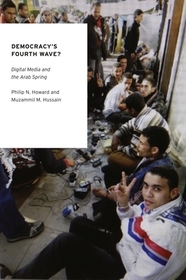
Democracy's Fourth Wave?
Digital Media and the Arab Spring
Series: Oxford Studies in Digital Politics;
- Publisher's listprice GBP 38.49
-
17 378 Ft (16 550 Ft + 5% VAT)
The price is estimated because at the time of ordering we do not know what conversion rates will apply to HUF / product currency when the book arrives. In case HUF is weaker, the price increases slightly, in case HUF is stronger, the price goes lower slightly.
- Discount 10% (cc. 1 738 Ft off)
- Discounted price 15 640 Ft (14 895 Ft + 5% VAT)
Subcribe now and take benefit of a favourable price.
Subscribe
17 378 Ft

Availability
printed on demand
Why don't you give exact delivery time?
Delivery time is estimated on our previous experiences. We give estimations only, because we order from outside Hungary, and the delivery time mainly depends on how quickly the publisher supplies the book. Faster or slower deliveries both happen, but we do our best to supply as quickly as possible.
Product details:
- Publisher OUP USA
- Date of Publication 4 April 2013
- ISBN 9780199936977
- Binding Paperback
- No. of pages160 pages
- Size 236x154x11 mm
- Weight 218 g
- Language English
- Illustrations 8 tables, 2 photographs, 5 graphs 0
Categories
Short description:
In 2011, the international community watched as citizens mobilized through the Internet and digital media to topple three of the world's most entrenched dictators: Ben Ali in Tunisia, Mubarak in Egypt, and Qaddafi in Libya. This book examines not only the unexpected evolution of events during the Arab Spring, but the longer history of desperate-and creative-digital activism through the Arab world.
MoreLong description:
In 2011, the international community watched as a shockingly unlikely community of citizens toppled three of the world's most entrenched dictators: Ben Ali in Tunisia, Mubarak in Egypt, and Qaddafi in Libya. This movement of cascading democratization, commonly known as the Arab Spring, was planned and executed not by political parties, but by students, young entrepreneurs, and the rising urban middle class. International experts and the popular press have pointed to the near-identical reliance on digital media in all three movements, arguing that these authoritarian regimes were in essence defeated by the Internet. Is that true? Should Mubarak blame Twitter for his sudden fall from power? Did digital media "cause" the Arab Spring?
In Democracy's Fourth Wave?, Philip N. Howard and Muzammil M. Hussain examine the complex role of the Internet, mobile phones, and social networking applications in the Arab Spring. Examining digital media access, level of grievance, and levels of protest for popular democratization in 16 countries in the Middle East and North Africa, Howard and Hussain conclude that digital media was neither the most nor the least important cause of the Arab Spring. Instead, they illustrate a complex web of conjoined causal factors for social mobilization. The Arab revolts cascaded across countries largely because digital media allowed communities to realize shared grievances and nurtured transportable strategies for mobilizing against dictators. Individuals were inspired to protest for personal reasons, but through social media they acted collectively.
Democracy's Fourth Wave examines not only the unexpected evolution of events during the Arab Spring, but the longer history of desperate-and creative-digital activism through the Arab world.
Democracy's Fourth Wave? guides readers through the avalanche of factors that meshed with digital media to produce the Arab Spring. The authors subtly adapt traditional methodologies to decode mysteries of complex causal effects. In doing so, their book brings clarity and insight to the conundrums of new technologies as factors in regime fragility and protest success.
Table of Contents:
List of Tables
List of Figures
Acknowledgements
Dedication
Introduction
Chapter 1: Digital Media and the Arab Spring
Chapter 2: The Recent History of Digital Media and Dissent
Chapter 3: Information Infrastructure and the Organization of Protest
Chapter 4: Authoritarian Responses and Consequences
Chapter 5: Al Jazeera, Social Media, and Digital Journalism
Conclusion: Digital Media and the Rhythms of Social Change
References
Endnotes
Index

