

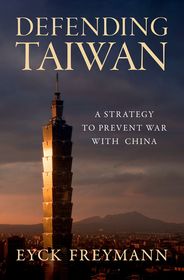
Defending Taiwan
A Strategy to Prevent War with China
- Publisher's listprice GBP 22.99
-
10 379 Ft (9 885 Ft + 5% VAT)
The price is estimated because at the time of ordering we do not know what conversion rates will apply to HUF / product currency when the book arrives. In case HUF is weaker, the price increases slightly, in case HUF is stronger, the price goes lower slightly.
- Discount 10% (cc. 1 038 Ft off)
- Discounted price 9 341 Ft (8 897 Ft + 5% VAT)
Subcribe now and take benefit of a favourable price.
Subscribe
10 379 Ft

Availability
Estimated delivery time: In stock at the publisher, but not at Prospero's office. Delivery time approx. 3-5 weeks.
Not in stock at Prospero.
Why don't you give exact delivery time?
Delivery time is estimated on our previous experiences. We give estimations only, because we order from outside Hungary, and the delivery time mainly depends on how quickly the publisher supplies the book. Faster or slower deliveries both happen, but we do our best to supply as quickly as possible.
Product details:
- Publisher OUP USA
- Date of Publication 15 July 2026
- ISBN 9780197823842
- Binding Hardback
- No. of pages432 pages
- Size 236x165x29 mm
- Weight 748 g
- Language English 0
Categories
Short description:
In Defending Taiwan, Eyck Freymann presents the first comprehensive and actionable strategy to prevent war with China and preserve an honorable peace. Freymann argues that Washington's deterrence strategy must extend beyond military means or threats of nuclear or economic mutually assured destruction. America also needs a bold new vision of technological and economic statecraft and a plan to secure its vital interests if deterrence fails. Urgent and indispensable, Defending Taiwan is the first true grand strategy to ensure lasting stability in the US-China relationship.
MoreLong description:
Sober, balanced, rigorously researched, and eminently readable, Defending Taiwan is a definitive guide to preventing World War III.
Taiwan is where the uneasy peace between the United States and China will be tested--and possibly broken. Beijing believes that "reunification" is inevitable. American military strength has preserved peace and stability for decades, but its advantages are eroding. Beijing has found critical gaps in U.S. strategy and is working to squeeze, isolate, and coerce Taiwan into submission without firing a shot. If deterrence fails, the consequences of a Taiwan crisis would be catastrophic--plunging the global economy into chaos, shattering U.S. alliances, and allowing China to dominate the region and reshape the world order.
In Defending Taiwan, Eyck Freymann presents the first integrated strategy to deter war with China and preserve an honorable peace. Drawing on untranslated Chinese sources, cutting-edge military and economic analysis, and deep historical research, Freymann argues that Washington's deterrence strategy must extend beyond conventional military power and familiar threats of mutually assured destruction. America must work with allies to develop a bold new vision of technological and economic statecraft--and a plan to secure its interests if deterrence fails. Freymann examines China's full range of strategic options. The United States can deter them all. But to do so, it must integrate its military strength, economic leverage, technological leadership, and diplomatic influence into a single, coherent plan to prevent war.
This is not just a book about Taiwan. It is a grand strategy to ensure lasting stability in the U.S.-China relationship. Defending Taiwan is the definitive guide to the world's most dangerous geopolitical challenge.
In Defending Taiwan, Eyck Freymann offers an innovative, multidimensional strategy integrating military, political, economic, and technological tools to enhance deterrence and defeat China if war occurs. This is an essential book for policy practitioners and scholars seeking innovative and feasible ways to protect Taiwan's democracy and secure America's interests in the Indo-Pacific.
Table of Contents:
Note on Authorship
Note on Terminology
Introduction
I. The Challenge
The Cross-Strait Dispute
II. Scenarios
The Gray Zone
Amphibious Invasion and Blockade
III. The Pillars of Deterrence
Political Deterrence
Strengthening Conventional Deterrence
Preserving Strategic Stability and U.S. Technological Leadership
Rethinking Economic Deterrence
Avalanche Decoupling
Conclusion: Living History
Acknowledgements
Appendix A
Appendix B
Notes
Index

