

- Publisher's listprice GBP 9.99
-
4 510 Ft (4 295 Ft + 5% VAT)
The price is estimated because at the time of ordering we do not know what conversion rates will apply to HUF / product currency when the book arrives. In case HUF is weaker, the price increases slightly, in case HUF is stronger, the price goes lower slightly.
- Discount 10% (cc. 451 Ft off)
- Discounted price 4 059 Ft (3 866 Ft + 5% VAT)
Subcribe now and take benefit of a favourable price.
Subscribe
4 510 Ft

Availability
Estimated delivery time: In stock at the publisher, but not at Prospero's office. Delivery time approx. 3-5 weeks.
Not in stock at Prospero.
Why don't you give exact delivery time?
Delivery time is estimated on our previous experiences. We give estimations only, because we order from outside Hungary, and the delivery time mainly depends on how quickly the publisher supplies the book. Faster or slower deliveries both happen, but we do our best to supply as quickly as possible.
Product details:
- Publisher OUP USA
- Date of Publication 28 April 2016
- ISBN 9780199340491
- Binding Paperback
- No. of pages136 pages
- Size 173x109x10 mm
- Weight 91 g
- Language English
- Illustrations 10 30
Categories
Short description:
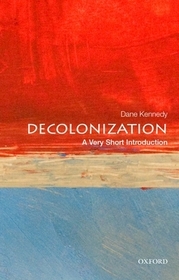
This succinct and insightful account of decolonization analyses the tumultuous events that caused the shift from a world of colonial empires to a world of nation-states in the years after World War II.
MoreLong description:
Millions of Africans, Asians, and other peoples were the subjects of colonial rule by overseas empires through the mid-twentieth century. By the end of the century, however, nearly all of these peoples had become citizens of independent nation-states. The United Nations grew from 51 member states at its founding in 1945 to 193 today. Its nearly four-fold increase is one measure of the historic shift in international relations that has occurred over the past half-century. Decolonization is the term commonly used to refer to this transition from a world of colonial empires to a world of nation-states in the years after World War II.
Both ex-imperial states and post-colonial regimes have promoted a selective and sanitized version of decolonization that casts their own conduct in a positive light, characterizing the process as negotiated and the outcome as inevitable. This book draws on recent scholarship to challenge that view, demonstrating that considerable violence and instability accompanied the end of empire and that the outcome was often up for grabs.
This book highlights three themes. The first is that global war between empires precipitated decolonization, creating the economic and political crises that gave colonial subjects the opportunity to seek independence. The second theme is that nation-state was not the only option pursued by anti-colonial activists. Many of them sought pan- and trans-national polities instead, but a combination of international and institutional pressures made the nation-state the standard template. The third theme is that the struggle to escape imperial subjugation and create nation-states generated widespread violence and produced huge refugee populations, leading to political problems that persist to the present day. By focusing on these crucial points, Dane Kennedy reminds us how the tumultuous, even tragic, changes caused by the decolonization profoundly shaped the world we live in.
Kennedy's brief book will undoubtedly become a key resource for teaching the end of empire. It serves as an ideal launching point for anyone new to the field, whether they are interested in gaining a general understanding of decolonization or in finding ways to delve more deeply into the complications, chronologies, and meanings of the end of empire.
Table of Contents:
1 Waves of Decolonization
2 Global War's Colonial Consequences
3 The Deluge
4 The Problem of the Nation-State
5 Imperial Continuities and the Politics of Amnesia
References
Further Reading
Index

