

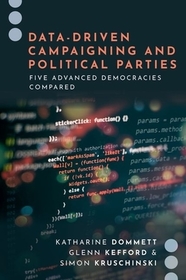
Data-Driven Campaigning and Political Parties
Five Advanced Democracies Compared
Series: Journalism and Political Communication Unbound;
- Publisher's listprice GBP 19.99
-
9 025 Ft (8 595 Ft + 5% VAT)
The price is estimated because at the time of ordering we do not know what conversion rates will apply to HUF / product currency when the book arrives. In case HUF is weaker, the price increases slightly, in case HUF is stronger, the price goes lower slightly.
- Discount 10% (cc. 903 Ft off)
- Discounted price 8 122 Ft (7 736 Ft + 5% VAT)
Subcribe now and take benefit of a favourable price.
Subscribe
9 025 Ft

Availability
Estimated delivery time: In stock at the publisher, but not at Prospero's office. Delivery time approx. 3-5 weeks.
Not in stock at Prospero.
Why don't you give exact delivery time?
Delivery time is estimated on our previous experiences. We give estimations only, because we order from outside Hungary, and the delivery time mainly depends on how quickly the publisher supplies the book. Faster or slower deliveries both happen, but we do our best to supply as quickly as possible.
Product details:
- Publisher OUP USA
- Date of Publication 28 March 2024
- ISBN 9780197570234
- Binding Paperback
- No. of pages256 pages
- Size 160x226x27 mm
- Weight 363 g
- Language English 474
Categories
Short description:
Challenging the often-hyperbolic claims that have been made around the use of data in election campaigns for voter manipulation and suppression, this book provides unrivalled evidence of how parties actually behave. It shows that data-driven campaigning practice is not inherently problematic or new, but neither is it uniform, rather systemic, regulatory and party level factors affecting the nature of campaigning. Providing detailed empirical examples from Australia, Canada, Germany, the UK and US, this book shows how parties campaign and explains why parties differ, thereby resetting prevailing understanding of the role of data in campaigns.
MoreLong description:
What is data-driven campaigning? According to prevailing accounts, this idea describes the rise of increasingly sophisticated, highly targeted, and often invasive uses of data deployed to suppress votes, manipulate voter preferences, or boost a candidates' popularity. The power of data is seen to be transforming campaigning practice and raising democratic concerns. And yet, there is a significant problem with these ideas: we have at best a partial understanding of how data-driven campaigning is practiced, and limited clarity about its implications.
Presenting data from interviews with over 300 professional campaigners in Australia, Canada, Germany, the UK and US, we provide unique insight into the components of data-driven campaigning by political parties. This book makes three key contributions. First, distinguishing between data, analytics, technology and personnel, they give unmatched descriptive insight into these four components of data-driven campaigning, revealing significant variation in its operationalization, depending on party and country context. Second, introducing a novel multi-level theoretical framework, they isolate systemic, regulatory, and party level variables that help explain the reasons for these differences. Third, they consider the implications of their findings for debates about democracy, data and technology in the 21st century.
Cumulatively, these contributions reveal that data-driven campaigning is not inherently problematic. Giving voice to practitioner perspectives, through interviews and innovative vignettes, this book recasts the debate around data-driven campaigning, offering important lessons for scholars, campaigners, and policymakers alike.
This is an incredible book that takes a much-needed internationally comparative approach, offering important and nuanced insights into the practice of Data-Driven Campaigning. It is a captivating and thought-provoking read for anyone interested in data use in modern election campaigns.
Table of Contents:
Introduction
Chapter 2: Theoretical Framework
Chapter 3: Data
Chapter 4: Analytics
Chapter 5: Technology
Chapter 6: Personnel
Chapter 7: Explaining variation in DDC
Chapter 8: Conclusion
References

