

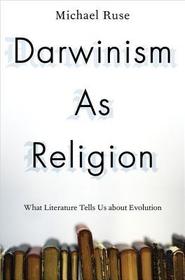
Darwinism as Religion
What Literature Tells Us about Evolution
- Publisher's listprice GBP 47.99
-
21 667 Ft (20 635 Ft + 5% VAT)
The price is estimated because at the time of ordering we do not know what conversion rates will apply to HUF / product currency when the book arrives. In case HUF is weaker, the price increases slightly, in case HUF is stronger, the price goes lower slightly.
- Discount 10% (cc. 2 167 Ft off)
- Discounted price 19 500 Ft (18 572 Ft + 5% VAT)
Subcribe now and take benefit of a favourable price.
Subscribe
21 667 Ft

Availability
printed on demand
Why don't you give exact delivery time?
Delivery time is estimated on our previous experiences. We give estimations only, because we order from outside Hungary, and the delivery time mainly depends on how quickly the publisher supplies the book. Faster or slower deliveries both happen, but we do our best to supply as quickly as possible.
Product details:
- Publisher OUP USA
- Date of Publication 3 November 2016
- ISBN 9780190241025
- Binding Hardback
- No. of pages328 pages
- Size 163x239x33 mm
- Weight 794 g
- Language English 0
Categories
Short description:
Darwinism as Religion argues that the theory of evolution given by Charles Darwin in the nineteenth century has always functioned as much as a secular form of religion as anything purely scientific. Through the words of novelists and poets, Michael Ruse argues that Darwin took us from the secure world of Christian faith into a darker, less friendly world of chance and lack of meaning.
MoreLong description:
The Darwinian Revolution--the change in thinking sparked by Charles Darwin's On the Origin of Species, which argued that all organisms including humans are the end product of a long, slow, natural process of evolution rather than the miraculous creation of an all-powerful God--is one of the truly momentous cultural events in Western Civilization. Darwinism as Religion is an innovative and exciting approach to this revolution through creative writing, showing how the theory of evolution as expressed by Darwin has, from the first, functioned as a secular religion.
Drawing on a deep understanding of both the science and the history, Michael Ruse surveys the naturalistic thinking about the origins of organisms, including the origins of humankind, as portrayed in novels and in poetry, taking the story from its beginnings in the Age of Enlightenment in the 18th century right up to the present. He shows that, contrary to the opinion of many historians of the era, there was indeed a revolution in thought and that the English naturalist Charles Darwin was at the heart of it. However, contrary also to what many think, this revolution was not primarily scientific as such, but more religious or metaphysical, as people were taken from the secure world of the Christian faith into a darker, more hostile world of evolutionism.
In a fashion unusual for the history of ideas, Ruse turns to the novelists and poets of the period for inspiration and information. His book covers a wide range of creative writers - from novelists like Voltaire and poets like Erasmus Darwin in the eighteenth century, through the nineteenth century with novelists including Elizabeth Gaskell, George Eliot, Thomas Hardy, Henry James and H. G. Wells and poets including Robert Browning, Alfred Tennyson, Walt Whitman, Emily Dickinson and Gerard Manley Hopkins, and on to the twentieth century with novelists including Edith Wharton, D. H. Lawrence, John Steinbeck, William Golding, Graham Greene, Ian McEwan and Marilynne Robinson, and poets including Robert Frost, Edna St Vincent Millay and Philip Appleman. Covering such topics as God, origins, humans, race and class, morality, sexuality, and sin and redemption, and written in an engaging manner and spiced with wry humor, Darwinism as Religion gives us an entirely fresh, engaging and provocative view of one of the cultural highpoints of Western thought.
[T]he point of Ruse's book is not to analyze the details of the arguments for and against Darwinism as a religion. Rather, Ruse seeks simply to demonstrate the existence of such a religious perspective, and to show that its influence can be fruitfully studied by analyzing literature. In this task Ruse succeeds, and his book will surely inspire further research into the topic.
Table of Contents:
Preface
Prologue
Chapter One: The Eighteenth Century
Chapter Two: Before Darwin
Chapter Three: The Darwinian Theory
Chapter Four: Reception
Chapter Five: God
Chapter Six: Origins
Chapter Seven: Humans
Chapter Eight: Race and Class
Chapter Nine: Morality
Chapter Ten: Sex
Chapter Eleven: Sin and Redemption
Chapter Twelve: The Future
Chapter Thirteen: Three Nobel Laureates
Chapter Fourteen: Towards the Present
Chapter Fifteen: The Conflict Continues
Chapter Sixteen: After Twin Towers
Epilogue
Bibliography
Index

