

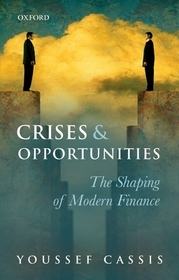
Crises and Opportunities
The Shaping of Modern Finance
- Publisher's listprice GBP 37.99
-
17 152 Ft (16 335 Ft + 5% VAT)
The price is estimated because at the time of ordering we do not know what conversion rates will apply to HUF / product currency when the book arrives. In case HUF is weaker, the price increases slightly, in case HUF is stronger, the price goes lower slightly.
- Discount 10% (cc. 1 715 Ft off)
- Discounted price 15 437 Ft (14 702 Ft + 5% VAT)
Subcribe now and take benefit of a favourable price.
Subscribe
17 152 Ft

Availability
printed on demand
Why don't you give exact delivery time?
Delivery time is estimated on our previous experiences. We give estimations only, because we order from outside Hungary, and the delivery time mainly depends on how quickly the publisher supplies the book. Faster or slower deliveries both happen, but we do our best to supply as quickly as possible.
Product details:
- Publisher OUP Oxford
- Date of Publication 14 March 2013
- ISBN 9780199672431
- Binding Paperback
- No. of pages218 pages
- Size 215x141x11 mm
- Weight 290 g
- Language English 0
Categories
Short description:
This book examines the differences and commonalities of eight global financial crises since the late nineteenth century (including the Great Depression of the 1930s and the Financial Debacle of the early twenty-first century) to give insights into how the financial landscape has - or has not - been reshaped after a systemic shock
MoreLong description:
As the world's political and economic leaders struggle with the aftermath of the Financial Debacle of 2008, this book asks the question: have financial crises presented opportunities to rebuild the financial system?
Examining eight global financial crises since the late nineteenth century, this new historical study offers insights into how the financial landscape - banks, governance, regulation, international cooperation, and balance of power - has been (or failed to be) reshaped after a systemic shock. It includes careful consideration of the Great Depression of the 1930s, the only experience of comparable moment to the recession of the early twenty-first century, yet also marked in its differences.
Taking into account not only the economic and business aspects of financial crises, but also their political and socio-cultural dimensions, the book highlights both their idiosyncrasies and common features, and assesses their impact in the broader context of long-term historical development.
Youssef Cassis attempts to describe and explain the nature of modern bank crises: what creates them, why they happen and how they are resolved. This is a challenging subject for any study, and Cassis effortlessly carries it off ... The book greatly aids our understanding of financial crises.
Table of Contents:
Foreword
Introduction
Pre-War Crises
Post-War Crises
Banks
Governance
Regulation
International Cooperation
Balance of Power
Conclusion

