

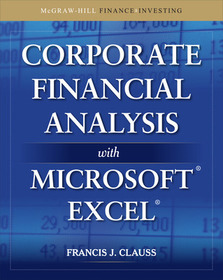
Corporate Financial Analysis with Microsoft Excel
Series: PROFESSIONAL FINANCE & INVESTM;
- Publisher's listprice GBP 85.99
-
38 824 Ft (36 975 Ft + 5% VAT)
The price is estimated because at the time of ordering we do not know what conversion rates will apply to HUF / product currency when the book arrives. In case HUF is weaker, the price increases slightly, in case HUF is stronger, the price goes lower slightly.
- Discount 10% (cc. 3 882 Ft off)
- Discounted price 34 941 Ft (33 278 Ft + 5% VAT)
Subcribe now and take benefit of a favourable price.
Subscribe
38 824 Ft

Availability
printed on demand
Why don't you give exact delivery time?
Delivery time is estimated on our previous experiences. We give estimations only, because we order from outside Hungary, and the delivery time mainly depends on how quickly the publisher supplies the book. Faster or slower deliveries both happen, but we do our best to supply as quickly as possible.
Product details:
- Publisher McGraw Hill
- Date of Publication 16 October 2009
- ISBN 9780071628853
- Binding Hardback
- No. of pages528 pages
- Size 261x213x23 mm
- Weight 1193 g
- Language English 0
Categories
Short description:
Executive guidance forenhancing business managementthrough spreadsheets
Learning from spreadsheet models is cheaper, faster, and less hazardous than learning in the realworld. Corporate Financial Analysis with Microsoft® Excel® contains numerous examples demonstratinghow to use spreadsheet models to help you manage more effectively under a wide range ofconditions and assumptions. You’ll learn how to use Excel’s powerful tools to:
- Perform sensitivity analysis and alert managers to the financialimpact of unexpected conditions that might occur
- Identify the best strategies to maximize profits,minimize costs, and achieve other goals
- Use Monte Carlo simulation to provide a complete picture of the risksand probabilities of doing business in an uncertain environment
Corporate Financial Analysis with Microsoft® Excel® provides practical, real-life examples to help yourelate to both the quantitative and qualitative sides of business management. In addition to usingspreadsheets for analysis, you will learn how to apply them in management presentations that areconvincing, and be able to justify your recommendations.
Corporate Financial Analysis with Microsoft® Excel® helps you become a better manager and decisionmaker—not just a skilled spreadsheet programmer. In today’s evolving markets, it is a must-havetoolbox of skills for every manager.
MoreLong description:
Corporate Financial Analysis with Microsoft®Excel® visualizes spreadsheets as an effectivemanagement tool both for financial analysisand for coordinating its results and actionswith marketing, sales, production and serviceoperations, quality control, and other businessfunctions.
Taking an integrative view that promotesteamwork across corporate functions andresponsibilities, the book contains dozens ofcharts, diagrams, and actual Excel® screenshotsto reinforce the practical applications ofevery topic it covers. The first two sections—Financial Statements and Cash Budgeting—explain how to use spreadsheets for:
- Preparing income statements,balance sheets, and cashflow statements
- Performing vertical andhorizontal analyses offinancial statements
- Determining financial ratiosand analyzing their trendsand significance
- Combining quantitative andjudgmental techniques to improveforecasts of sales revenues andcustomer demands
- Calculating and applying thetime value of money
- Managing inventories,safety stocks, and theallocation of resources
The third and final section—Capital Budgeting—covers capital structure, the cost ofcapital, and leverage; the basics of capitalbudgeting, including taxes and depreciation;applications, such as new facilities, equipmentreplacement, process improvement, leasingversus buying, and nonresidential real estate;and risk analysis of capital budgets and thepotential impacts of unforeseen events.
Corporate Financial Analysis with Microsoft®Excel® takes a broad view of financial functionsand responsibilities in relation to thoseof other functional parts of modern corporations,and it demonstrates how to use spreadsheetsto integrate and coordinate them. Itprovides many insightful examples and casestudies of real corporations, including Wal-Mart, Sun Microsystems, Nike, H. J. Heinz,Dell, Microsoft, Apple Computer, and IBM.
Corporate Financial Analysis with Microsoft®Excel® is the ideal tool for managing yourfirm’s short-term operations and long-termcapital investments.
Corporate Financial Analysis with Microsoft®Excel® visualizes spreadsheets as an effectivemanagement tool both for financial analysisand for coordinating its results and actionswith marketing, sales, production and serviceoperations, quality control, and other businessfunctions.
Taking an integrative view that promotesteamwork across corporate functions andresponsibilities, the book contains dozens ofcharts, diagrams, and actual Excel® screenshotsto reinforce the practical applications ofevery topic it covers. The first two sections—Financial Statements and Cash Budgeting—explain how to use spreadsheets for:
- Preparing income statements,balance sheets, and cashflow statements
- Performing vertical andhorizontal analyses offinancial statements
- Determining financial ratiosand analyzing their trendsand significance
- Combining quantitative andjudgmental techniques to improveforecasts of sales revenues andcustomer demands
- Calculating and applying thetime value of money
- Managing inventories,safety stocks, and theallocation of resources
The third and final section—Capital Budgeting—covers capital structure, the cost ofcapital, and leverage; the basics of capitalbudgeting, including taxes and depreciation;applications, such as new facilities, equipmentreplacement, process improvement, leasingversus buying, and nonresidential real estate;and risk analysis of capital budgets and thepotential impacts of unforeseen events.
Corporate Financial Analysis with Microsoft®Excel® takes a broad view of financial functionsand responsibilities in relation to thoseof other functional parts of modern corporations,and it demonstrates how to use spreadsheetsto integrate and coordinate them. Itprovides many insightful examples and casestudies of real corporations, including Wal-Mart, Sun Microsystems, Nike, H. J. Heinz,Dell, Microsoft, Apple Computer, and IBM.
Corporate Financial Analysis with Microsoft®Excel® is the ideal tool for managing yourfirm’s short-term operations and long-termcapital investments.
MoreTable of Contents:
1: Corporate Financial Statements 2: Analysis of Financial Statements 3: Forecasting Annual Revenues 4: Forecasting Financial Statements 5: Forecasting Seasonal Revenues 6: Time Value of Money 7: Cash Budgeting 8: Cost of Capital 9: Profits, Leverage 10: Depreciation, Taxes 11: Capital Budgeting 12: Applications of Capital Budgeting 13: Capital Budgeting: Risk Analysis 14: Capital Budgeting: Monte Carlo
More
