

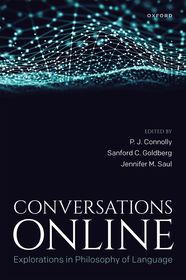
Conversations Online
Explorations in Philosophy of Language
- Publisher's listprice GBP 113.00
-
51 019 Ft (48 590 Ft + 5% VAT)
The price is estimated because at the time of ordering we do not know what conversion rates will apply to HUF / product currency when the book arrives. In case HUF is weaker, the price increases slightly, in case HUF is stronger, the price goes lower slightly.
- Discount 10% (cc. 5 102 Ft off)
- Discounted price 45 918 Ft (43 731 Ft + 5% VAT)
Subcribe now and take benefit of a favourable price.
Subscribe
51 019 Ft

Availability
Estimated delivery time: In stock at the publisher, but not at Prospero's office. Delivery time approx. 3-5 weeks.
Not in stock at Prospero.
Why don't you give exact delivery time?
Delivery time is estimated on our previous experiences. We give estimations only, because we order from outside Hungary, and the delivery time mainly depends on how quickly the publisher supplies the book. Faster or slower deliveries both happen, but we do our best to supply as quickly as possible.
Product details:
- Publisher OUP Oxford
- Date of Publication 15 May 2025
- ISBN 9780198872085
- Binding Hardback
- No. of pages448 pages
- Size 242x165x32 mm
- Weight 806 g
- Language English 604
Categories
Short description:
This book&&&8212the first collection of its kind&&&8212collates work from numerous philosophers of language on a diverse range of topics that arise in online conversation.
MoreLong description:
The growth of communication technologies has profoundly and inescapably impacted politics, society, and how we coordinate our lives. One of the central components of this change has been the transformation in our communicative possibilities. Amongst other things, the internet has given rise to new linguistic phenomena, novel ways of doing things with words, and new types of communicative behaviour. It has created communicative possibilities that we might think are broadly positive, and yet it has also been instrumental in&&&8212and the locus for&&&8212the spread of malevolent types of speech.
Conversations Online collects eighteen original contributions from twenty-six philosophers of language. These thinkers are well-placed to provide insights that can help us sift through and understand linguistic phenomena in online settings, considering them in terms of existing theories and providing analyses that will be helpful for anybody who is interested in online communication. Together they show that great possibilities are available to us when we look at conversations online and develop a broader understanding of how language develops in digital settings. This diverse volume will not only advance the topic of online communication within philosophy of language&&&8212it will also equip readers with a better understanding of the utility of the field and the many ways in which technological developments are changing how we interact.
Chapter 2 of this work is available under the terms of a CC BY-NC-ND 4.0 International open access licence. This part of the work is free to read on the Oxford Academic platform and offered as a free PDF download from OUP and selected open access locations.
Table of Contents:
Acknowledgments
List of Contributors
Introduction
Part One: Context Online
Hit and Run Speech Acts: Not A Conversation
The Many-to-Many Model: Communication, Attention, and Trust in Online Conversations
Sharing Content Online: the Effects of Likes and Comments on Linguistic Interpretation
Context Collapse Online
Imagined Audiences and Common Ground
Part Two: Commitments, Community and Cooperation Online
Context Collapse and Pop-Up Communities: How Social Media Makes its Own Norms
Commitment Online: On Taking Responsibility for One's Words on Social Media
Conversational Goals and Internet Trolls
Conversations with Chatbots
Online Communication and Political Ideology
Part Three: Speech Acts Online
Complex Harms in Online Speech: The Limits of the Illocutionary
Sarcasm Online
On Subtweeting
A Meme for Excuses
Part Four: Improving Conversations Online
New Atlantis 2.0: Designing Epistemically-Healthy Online Conversations
What's Distinctive About Blocking Implicit Toxicity Online
Online Propaganda and the Manipulation of Imaginative Possibilities
On Amplification

