

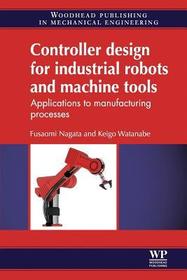
Controller Design for Industrial Robots and Machine Tools
Applications to Manufacturing Processes
- Publisher's listprice EUR 155.00
-
64 286 Ft (61 225 Ft + 5% VAT)
The price is estimated because at the time of ordering we do not know what conversion rates will apply to HUF / product currency when the book arrives. In case HUF is weaker, the price increases slightly, in case HUF is stronger, the price goes lower slightly.
- Discount 10% (cc. 6 429 Ft off)
- Discounted price 57 858 Ft (55 103 Ft + 5% VAT)
Subcribe now and take benefit of a favourable price.
Subscribe
64 286 Ft

Availability
cancelled
Why don't you give exact delivery time?
Delivery time is estimated on our previous experiences. We give estimations only, because we order from outside Hungary, and the delivery time mainly depends on how quickly the publisher supplies the book. Faster or slower deliveries both happen, but we do our best to supply as quickly as possible.
Product details:
- Publisher Elsevier Science
- Date of Publication 30 October 2018
- ISBN 9780081015421
- Binding Paperback
- No. of pages260 pages
- Size 234x156 mm
- Language English 0
Categories
Long description:
Advanced manufacturing systems are vital to the manufacturing industry. It is well known that if a target work piece has a curved surface, then automation of the polishing process is difficult. Controller design for industrial robots and machine tools presents results where industrial robots have been successfully applied to such surfaces, presenting up to date information on these advanced manufacturing systems, including key technologies. Chapters cover topics such as velocity-based discrete-time control system for industrial robots; preliminary simulation of intelligent force control; CAM system for an articulated industrial robot; a robot sander for artistic furniture; a machining system for wooden paint rollers; a polishing robot for PET bottle blow moulds; and a desktop orthogonal-type robot for finishing process of LED lens cavity; and concludes with a summary. The book is aimed at professionals with experience in industrial manufacturing, and engineering students at undergraduate and postgraduate level.
MoreTable of Contents:
List of figures
List of tables
Preface
About the authors
Introduction
Chapter 1: Velocity-based discrete-time control system with intelligent control concepts for openarchitecture industrial robots
Abstract:
1.1 Background
1.2 Basic Servo System
1.3 Dynamic simulation
1.4 In case of fuzzy control
1.5 In case of neural network
1.6 Conclusion
Chapter 2: Preliminary simulation of intelligent force control
Abstract:
2.1 Introduction
2.2 Impedance model following force control
2.3 Influence of environmental viscosity
2.4 Fuzzy environment model
2.5 Conclusion
Chapter 3: CAM system for articulated-type industrial robot
Abstract:
3.1 Background
3.1 Desired trajectory
3.3 Implementation to industrial robot RV1A
3.4 Experiment
3.5 Passive force control of industrial robot RV1A
3.6 Conclusion
Chapter 4: 3D robot sander for artistically designed furniture
Abstract:
4.1 Background
4.2 Feedfoward position/orientation control based on post-process of CAM
4.3 Hybrid position/force control with weak coupling
4.4 Robotic sanding system for wooden parts with curved surfaces
4.5 Surface-following control for robotic sanding system
4.6 Feedback control of polishing force
4.7 Feedforward and feedback control of position
4.8 Hyper CL data
4.9 Experimental result
4.10 Conclusion
Chapter 5: 3D machining system for artistic wooden paint rollers
Abstract:
5.1 Background
5.2 Conventional five-axis nc machine tool with a tilting head
5.3 Intelligent machining system for artistic design of wooden paint rollers
5.4 Experiments
5.5 Conclusion
Chapter 6: Polishing robot for pet bottle blow molds
Abstract:
6.1 Background
6.2 Generation of multi-axis cutter location data
6.3 Basic Polishing Scheme for a Ball End Abrasive Tool
6.4 Feedback Control of Polishing Force
6.5 Feedforward and Feedback Control of Tool Position
6.6 Update timing of CL data
6.7 Experiment
6.8 Conclusion
Chapter 7: Desktop orthogonal-type robot for LED lens cavities
Abstract:
7.1 Background
7.2 Limitation of a polishing system based on an articulated-type industrial robot
7.3 Desktop orthogonal-type robot with compliance controllability
7.4 Transformation technique of manipulated values from velocity to pulse
7.5 Desired damping considering the critically damped condition
7.6 Design of weak coupling control between force feedback loop and position feedback loop
7.7 Basic experiment
7.8 Frequency characteristics
7.9 Application to finishing an LED lens mold
7.10 Stickslip motion of tool
7.11 Neural Network-Based Stiffness Estimator
7.12 Automatic Tool Truing for Long-Time Lapping Process
7.13 Force Input Device
7.14 Conclusion
Chapter 8: Conclusion
Abstract:
References
Index
More
