

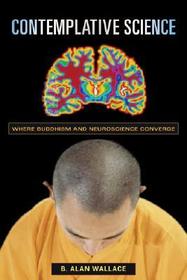
Contemplative Science
Where Buddhism and Neuroscience Converge
Series: Columbia Series in Science and Religion;
- Publisher's listprice GBP 100.00
-
45 150 Ft (43 000 Ft + 5% VAT)
The price is estimated because at the time of ordering we do not know what conversion rates will apply to HUF / product currency when the book arrives. In case HUF is weaker, the price increases slightly, in case HUF is stronger, the price goes lower slightly.
- Discount 10% (cc. 4 515 Ft off)
- Discounted price 40 635 Ft (38 700 Ft + 5% VAT)
Subcribe now and take benefit of a favourable price.
Subscribe
45 150 Ft

Availability
Estimated delivery time: In stock at the publisher, but not at Prospero's office. Delivery time approx. 3-5 weeks.
Not in stock at Prospero.
Why don't you give exact delivery time?
Delivery time is estimated on our previous experiences. We give estimations only, because we order from outside Hungary, and the delivery time mainly depends on how quickly the publisher supplies the book. Faster or slower deliveries both happen, but we do our best to supply as quickly as possible.
Product details:
- Publisher Columbia University Press
- Date of Publication 24 November 2006
- ISBN 9780231138345
- Binding Hardback
- No. of pages256 pages
- Size 228x152 mm
- Language English 0
Categories
Short description:
B. Alan Wallace, renowned Buddhist scholar, integrates the contemplative methodologies of Buddhism and Western science into a single discipline: contemplative science. The science of consciousness investigates the mind through Buddhist contemplative techniques, such as shamatha, an organized, detailed system of training the attention. Just as scientists make observations and conduct experiments with the aid of technology, contemplatives have long tested their theories with the help of highly developed meditative skills of observation and experimentation.
Contemplative science allows for a deeper knowledge of mental phenomena, and its emphasis on strict mental discipline counteracts the effects of conative (intention and desire), attentional, cognitive, and affective imbalances. Just as behaviorism, psychology, and neuroscience shed light on the cognitive processes enabling us to survive and flourish, contemplative science offers a groundbreaking perspective for expanding our capacity to realize genuine well-being. It also forges a link between the material world and the realm of the subconscious, transcending a traditional science-based understanding of the self.
MoreLong description:
B. Alan Wallace, renowned Buddhist scholar, integrates the contemplative methodologies of Buddhism and Western science into a single discipline: contemplative science. The science of consciousness investigates the mind through Buddhist contemplative techniques, such as shamatha, an organized, detailed system of training the attention. Just as scientists make observations and conduct experiments with the aid of technology, contemplatives have long tested their theories with the help of highly developed meditative skills of observation and experimentation.
Contemplative science allows for a deeper knowledge of mental phenomena, and its emphasis on strict mental discipline counteracts the effects of conative (intention and desire), attentional, cognitive, and affective imbalances. Just as behaviorism, psychology, and neuroscience shed light on the cognitive processes enabling us to survive and flourish, contemplative science offers a groundbreaking perspective for expanding our capacity to realize genuine well-being. It also forges a link between the material world and the realm of the subconscious, transcending a traditional science-based understanding of the self.
More
