

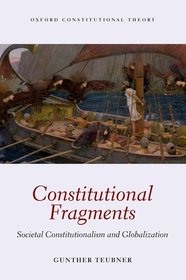
Constitutional Fragments
Societal Constitutionalism and Globalization
Series: Oxford Constitutional Theory;
- Publisher's listprice GBP 55.00
-
26 276 Ft (25 025 Ft + 5% VAT)
The price is estimated because at the time of ordering we do not know what conversion rates will apply to HUF / product currency when the book arrives. In case HUF is weaker, the price increases slightly, in case HUF is stronger, the price goes lower slightly.
- Discount 10% (cc. 2 628 Ft off)
- Discounted price 23 649 Ft (22 523 Ft + 5% VAT)
Subcribe now and take benefit of a favourable price.
Subscribe
26 276 Ft

Availability
printed on demand
Why don't you give exact delivery time?
Delivery time is estimated on our previous experiences. We give estimations only, because we order from outside Hungary, and the delivery time mainly depends on how quickly the publisher supplies the book. Faster or slower deliveries both happen, but we do our best to supply as quickly as possible.
Product details:
- Publisher OUP Oxford
- Date of Publication 30 January 2014
- ISBN 9780198713951
- Binding Paperback
- No. of pages232 pages
- Size 235x157x13 mm
- Weight 332 g
- Language English 20
Categories
Short description:
The powerful private sectors of the world economy remain largely unconstrained by fundamental constitutional rules, leading to human rights abuses on a massive scale. This book examines how the values of constitutional governance can be applied to the private sphere in the modern world, through a network of constitutional fragments.
MoreLong description:
In recent years a series of scandals have challenged the traditional political reliance on public constitutional law and human rights as a safeguard of human well-being. Multinational corporations have violated human rights; private intermediaries in the internet have threatened freedom of opinion, and the global capital markets unleashed catastrophic risks. All of these phenomena call for a response from traditional constitutionalism. Yet it is outside the limits of the nation-state in transnational politics and outside institutionalized politics, in the 'private' sectors of global society that these constitutional problems arise.
It is widely accepted that there is a crisis in traditional constitutionalism caused by transnationalization and privatization. How the crisis can be overcome is one of the major controversies of modern political and constitutional theory. This book sets out an answer to that problem. It argues that the obstinate state-and-politics-centricity of traditional constitutionalism needs to be counteracted by a sociological approach which, so far, has remained neglected in the constitutional debate. Constitutional sociology projects the questions of constitutionalism not only onto the relationship between public politics and law, but onto the whole society. It argues that constitutionalism has the potential to counteract the expansionist tendencies of social systems outside the state world, particularly of the globalized economy, science and technology, and the information media, when they endanger individual or institutional autonomy.
The book identifies transnational regimes, particularly in the private area, as the new constitutional subjects in a global society, rivals to the order and power of nation states. It presents a model of transnational, societal constitutional fragments that could bring the values of constitutionalism to bear on these private networks, examining the potential horizontal application of human rights in the private sphere, and how such fragments could interact. An original and provocative contribution to the literature on modern constitutionalism, Constitutional Fragments is essential reading for all those engaged in transnational political theory.
sociologists of law and constitutionalism now have powerful methodological tools, a sociological conceptual framework, and invaluable sources of the new constitutional imagination which has capacity to accommodate even recent elaborations on Nietzsche's theory of command structures
Table of Contents:
The New Constitutional Question
Societal Constitutionalism in the Nation State
Transnational Constitutional Subjects: Regimes, Organisations, Networks
Transnational Constitutional Norms: Functions, Arenas, Processes, Structures
Transnational Constitutional Rights: Horizontal Effect
Colliding Constitutions

